

Preface
To us, Anthropic is the most exciting institution yet built. We grew up in the Effective Altruism community, and its public-benefit structure and its work on bringing AI into the world safely resonate with us.
The most important company of our generation now needs public-market money to fund its next stage and to honour about $900B of compute commitments. You, the retail or fund investor, have to decide whether that is worth backing. This report answers the questions we find most pressing for that decision.
One admission. On each foundation-model investment or job Romil has weighed, he has made the classic mistake of being wrong in the short term, above all on how fast this layer turns into a commodity. Anthropic stands out today on model performance. The question we dig into is whether that advantage lasts or whether the extra benefit of a better model shrinks.
Whether or not Anthropic succeeds in the long run, expect to feel foolish at many points while its shares trade. Keep in mind the line usually attributed to Keynes: “The market can remain irrational longer than you can remain solvent.”
The note
The call and the argument behind it. Each section links to the deep dive that backs it.
Six things a buyer at $78 has to believe
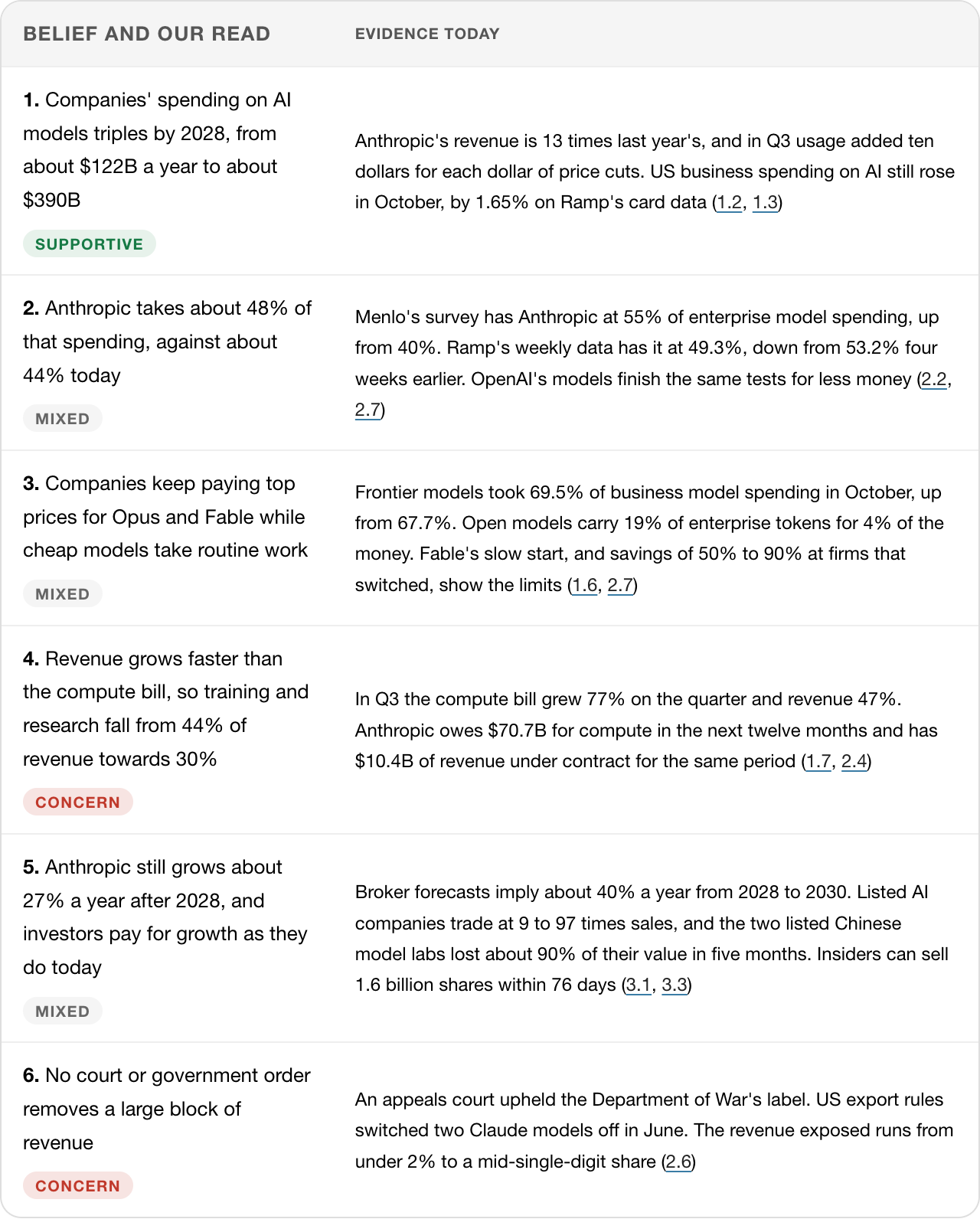
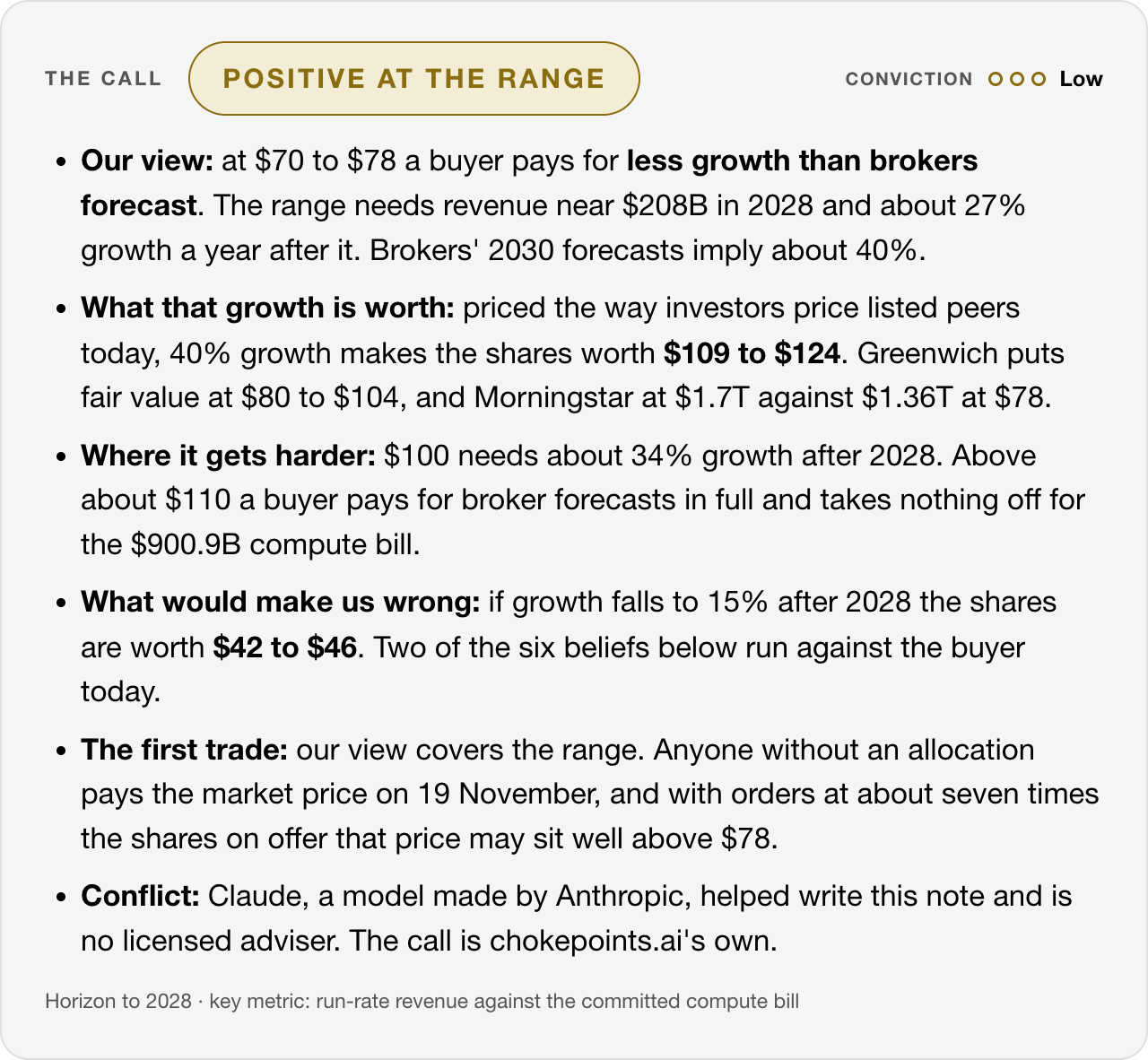
* The count: one belief has clear support, three are open and two run against the buyer today. A buyer at $78 needs all six.
1 At $78 you pay for 27% growth after 2028
Work back from $78 and you reach one number: the rate Anthropic still grows at after 2028. The range needs about 27% a year. Brokers forecast about 40%, so at the range you pay for two-thirds of what they expect.
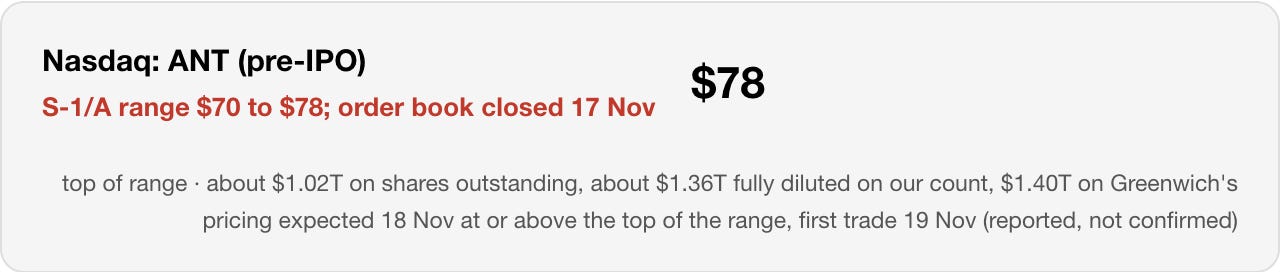
From price to value: $78 times 17.5 billion shares, counting options and awards, is $1.36T. For a 12% return a year the business has to be worth $1.50T in 2028, after taking off $213B of cash.
Why 2028: it is the first year in which brokers expect Anthropic to grow at a rate listed companies show today. They forecast 175% for 2027 and 38% for 2028, and no listed peer grows 175%.
How investors pay for growth: 15 listed AI infrastructure, cloud and software companies trade at 6.8 times next year's sales for 31% growth. That is about 0.2 times sales for each point of growth.
What $78 needs: $1.50T on $208B of 2028 revenue is 7.2 times sales, the rate those peers get for about 27% growth.
AI companies get more than software: listed AI companies trade at 9 to 97 times sales, against 2.2 for the median software company. Z.ai and MiniMax, the two Chinese model labs listed in Hong Kong, show the risk: both traded above 600 times sales and lost about 90% of their value in five months.
Why we take less than the peer rate: Anthropic owes $900.9B for compute whether revenue arrives or not. CoreWeave, which rents AI compute and carries $62B of net debt, trades at 9 times sales while growing 168%.
Each five points of growth after 2028 is worth about $15 a share
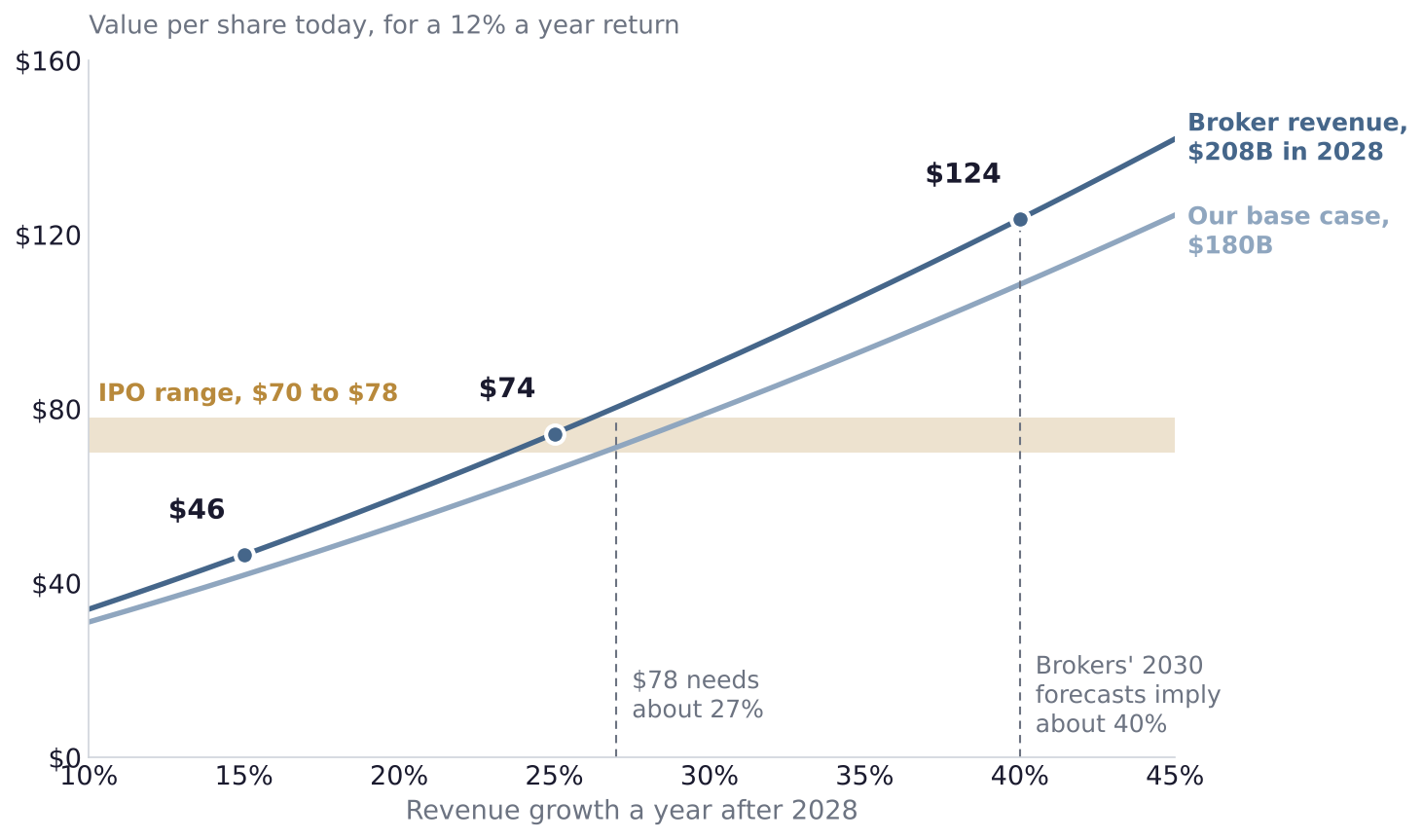
The range sits where growth after 2028 is about 27%. Brokers' forecasts sit at about 40%. chokepoints.ai arithmetic on the S-1/A share count and cash, and [Compound](https://getcompound.ai/blog/anthropic-ipo-valuation)'s peer data of 9 November.Compound's peer data of 9 November.*
Go deeper: 3.1 the full valuation
2 Growth can hold, and share is the weak point
The market is big enough. The average Fortune 500 customer spends under 0.1% of its costs on Claude, and usage is rising ten times faster than prices fall. Our worry is share: forecasts need Anthropic to take over half the market, and both weekly trackers turned down in late October.
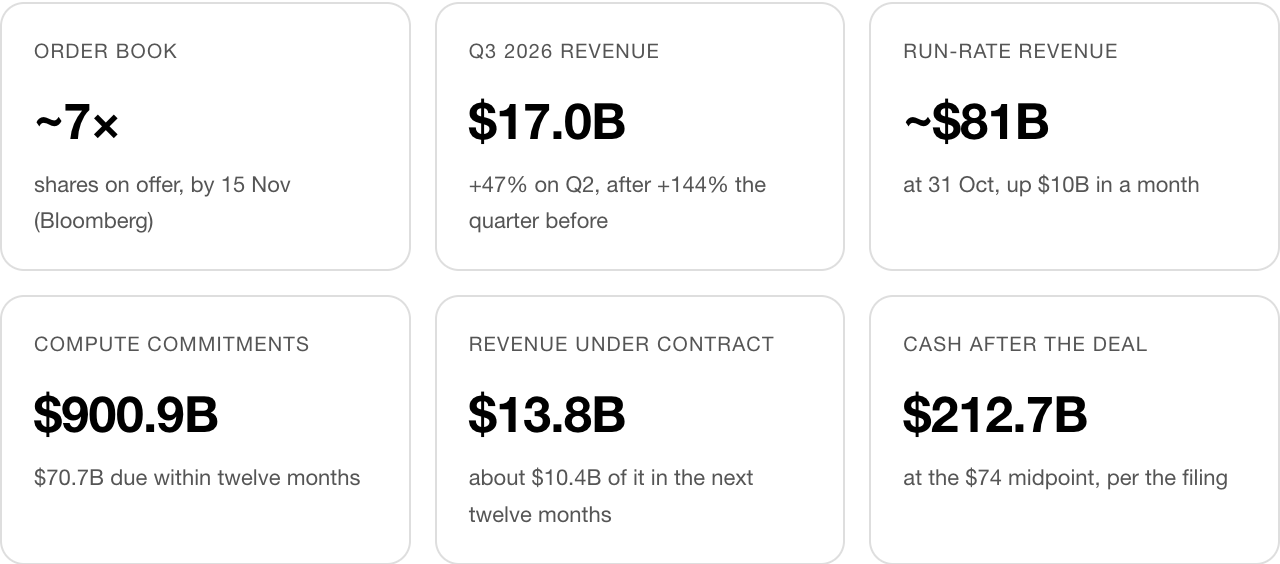
Revenue today: $17.0B in Q3, 12 times a year earlier. Quarterly growth slowed from 144% to 47%, and the pace at 31 October was $81B a year.
Room to grow: ICBC International forecasts the market for AI models at $122B this year and $393B in 2028. Claude costs the ten largest Fortune 500 customers under 1% of their costs, about eight times the average.
Price cuts have paid so far: in Q3 more usage added $6.0B of revenue and price cuts took off $0.6B.
Customers spend more each year: business customers from a year ago now spend nine times as much. Only $10.4B of the next twelve months' revenue is under contract, about 13% of today's pace.
Most of the money comes through other companies' software: we estimate a quarter to a third of revenue comes through Anthropic's own products, such as Claude Code, and the rest through the API. API customers can switch by changing a model name (1.1).
Share is the open question: broker forecasts put Anthropic at 53% to 56% of the model market by 2028, up from about 44%. Ramp, a corporate-card company that tracks what US businesses pay AI suppliers, had Anthropic at 49.3% of token spending in the week to 1 November, down from 60.5% in the week to 23 October.
Budgets are tightening: Uber, Tesla, Apple, Accenture and Microsoft have each capped what staff may spend on AI coding tools. On Ramp's panel token volume rose 37% in four weeks and spending rose 9%.
Broker forecasts need Anthropic to win more than half the market
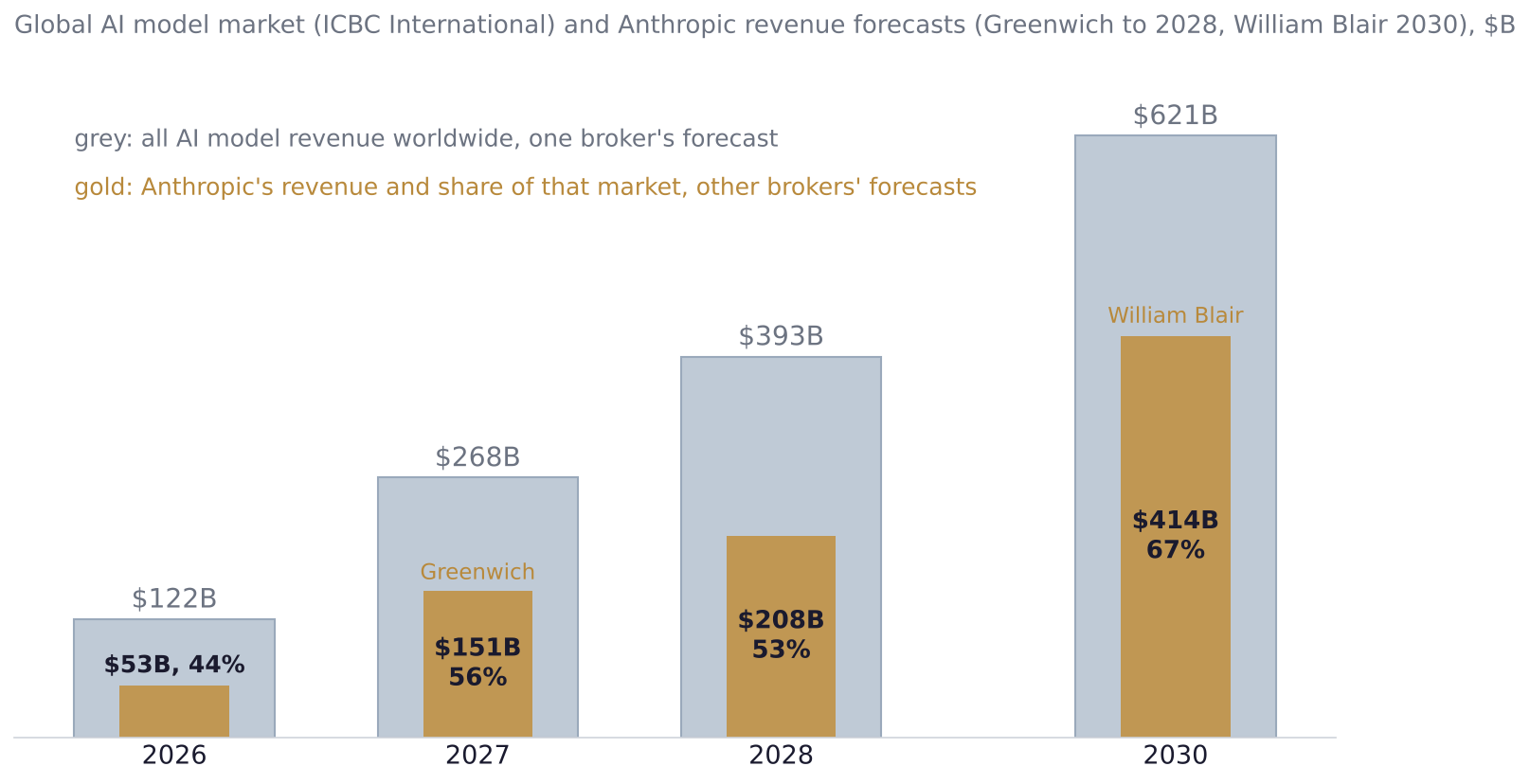
Anthropic's 2026 revenue is about 44% of one broker's estimate of the model market. Other brokers' revenue forecasts put it at 53% to 56% by 2027 and 2028. The two sets of forecasts come from different firms, so treat the shares as a cross-check. Sources: ICBC International, Greenwich Research, William Blair. Chart by chokepoints.ai.
Go deeper: 1.1 revenue, 1.2 market and share, 1.3 prices, 2.1 retention, 2.2 competition
3 Anthropic's lead lasts six months a release, and the money sits at the top
This is the question our preface says Romil has got wrong before, so we spent the most time on it. Open models from Chinese labs sit about six months behind Claude and cost a quarter to a fortieth as much per task. So far they have taken the tokens and left the money, and buyers have moved up to Opus faster than they have moved down.
* Where the money is: Opus takes about two-thirds of Claude spending on two outside panels, and Fable an eighth to a sixth. Haiku, the class that competes with cheap models on price, brings in 1% to 2%.
Opus and Fable bring in about four-fifths of what customers pay for Claude
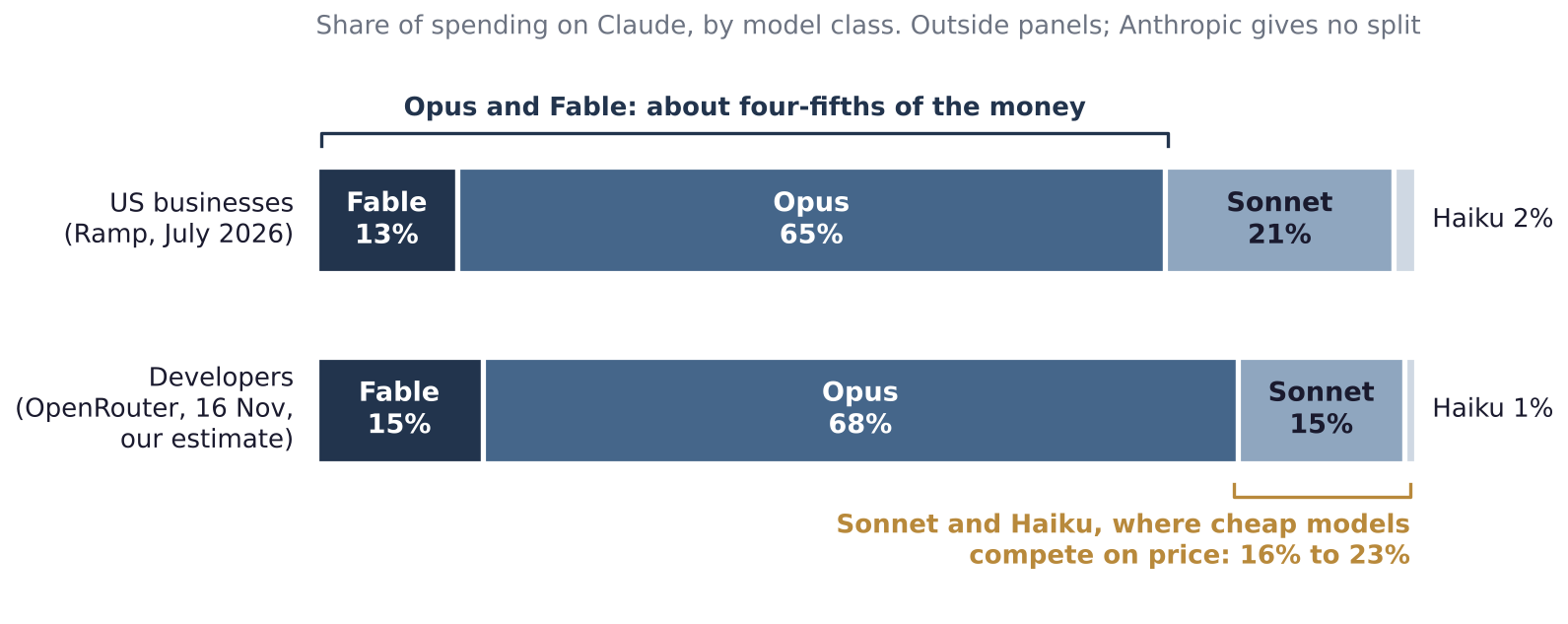
Anthropic gives no revenue by model. Both panels lean towards smaller firms and developers, and neither covers the 250 customers that spend $10M or more a year. Sources: Ramp AI Index; routers.vantage.sh token counts priced at Anthropic's list prices. Chart by chokepoints.ai.
Open models take volume: they carry 19% of enterprise tokens and 4% of the money, on a survey by Menlo Ventures, a venture firm that owns Anthropic shares. Frontier models took 69.5% of business model spending in October, up from 67.7%.
Switching works for routine tasks: Revolut, Coinbase, Lindy and Firetiger each cut 50% to 90% of the bill on the work they moved. Each kept a frontier model for hard tasks.
Anthropic has to buy the lead again each release: on the index kept by Epoch AI, a research non-profit, the best open model matches what the best closed model scored six months earlier. William Blair estimates training cost $3.2B for Opus 5 and $6.9B for Fable 5.
Training still pays in dollars: revenue grew 13 times on 5.4 times the research spending. Each dollar buys less progress, and two economists put the fall at about 69% in a year.
Buyers will pay only so much for capability: Fable 5 took 8% of business model spending in its second month at twice the price of Opus. Anthropic then cut Fable's price by 20%.
OpenAI is the closer rival: GPT-6.2 Astra ties or beats Fable 5.2 on science and coding tests and finishes tasks for less money. Claude leads on finance, tax and office work.
The cost to the price: if two-fifths of customers, measured by spending, halve their bills, our 2028 revenue falls from $180B to $144B and the value from $78 to $65 at eight times sales.
The lead reopens with each US release and averaged more in 2026 than in 2025
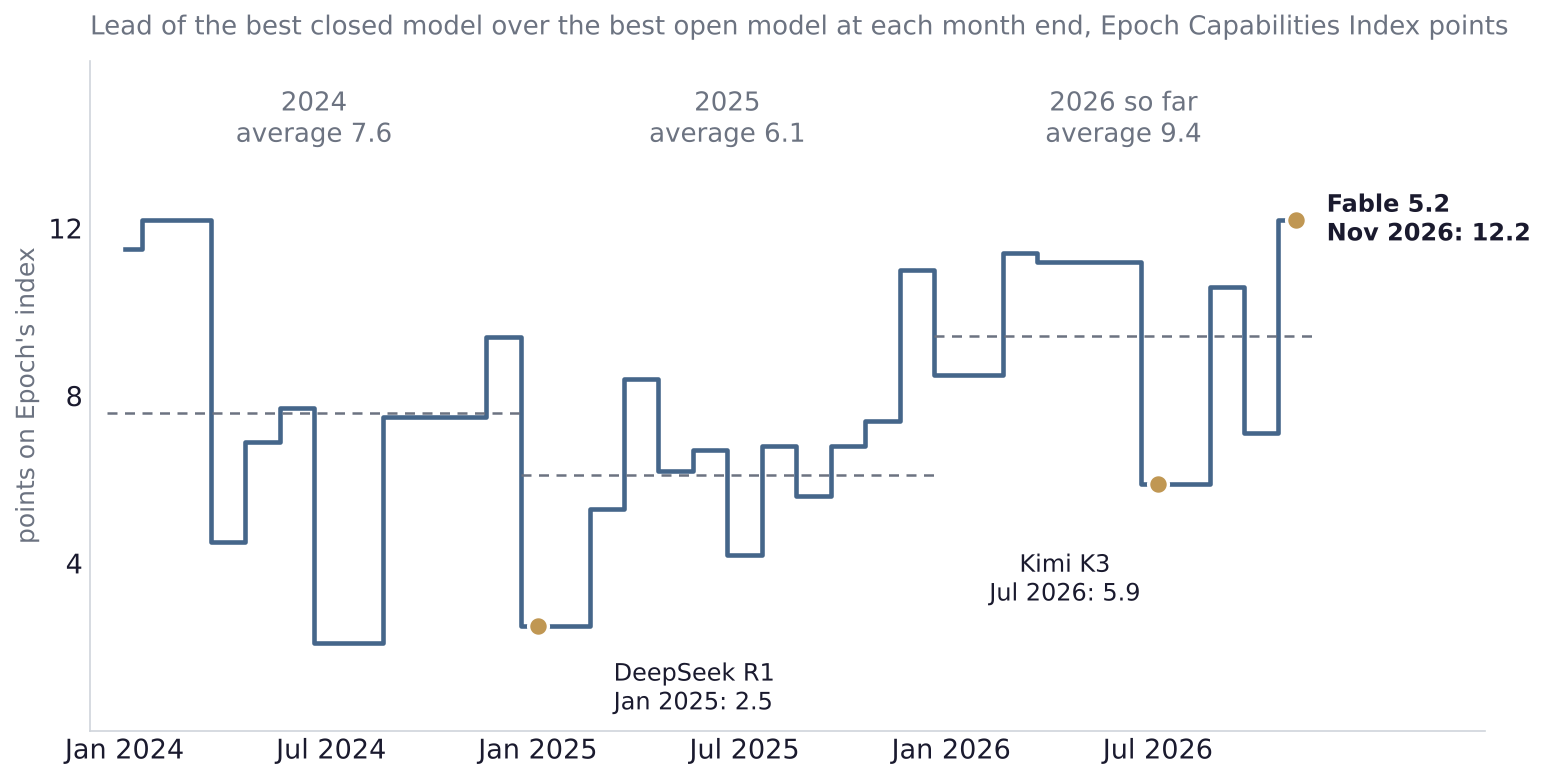
Each Chinese release narrows the lead and each US release restores it. At about two index points a month, 12 points is six months. Source: [Epoch AI](https://epoch.ai/data-insights/open-closed-eci-gap) data, as compiled by speedrunningai.com. Chart by chokepoints.ai.Epoch AI data, as compiled by speedrunningai.com. Chart by chokepoints.ai.*
Go deeper: 1.6 models and prices, 1.7 training, 2.7 Chinese and open models
4 Anthropic can pay the compute bill if revenue triples
The compute bill is the part of Anthropic we like least. It has signed for $900.9B, and in Q3 that bill grew faster than revenue. It holds enough cash to last about four years if growth stopped, so we see a risk to profit and to the multiple investors will pay, with solvency intact.
The size of it: $900.9B in total, with $451.6B due by 2030 and $70.7B in the next twelve months.
Where the compute goes: a quarter serves paying customers. Training, research and Anthropic's own use took $7.4B in Q3, or 44% of revenue, up from 40% in the first half.
The Q3 warning: the compute bill grew 77% on the quarter and revenue 47%. Revenue per dollar of compute fell from $2.08 to $1.72.
What the margin target needs: a 35% margin needs compute near 45% of revenue. On the payments already signed, that takes about $150B of revenue in the next twelve months, close to the $151B brokers forecast for 2027.
No broker gets there soon: Greenwich reaches a 30% margin in 2032 and William Blair in 2035. The adjusted margin leaves out stock pay of about $12B a year.
The cushion: $212.7B of cash after the deal, and operations produced $6.6B of cash in nine months. With revenue flat at $81B, we estimate the cash lasts a little over four years.
What Anthropic can cancel: $186.2B, if suppliers miss financing or site deadlines. Either side can end the SpaceXAI deal on 90 days' notice from early 2027.
What is fixed by contract over the next twelve months
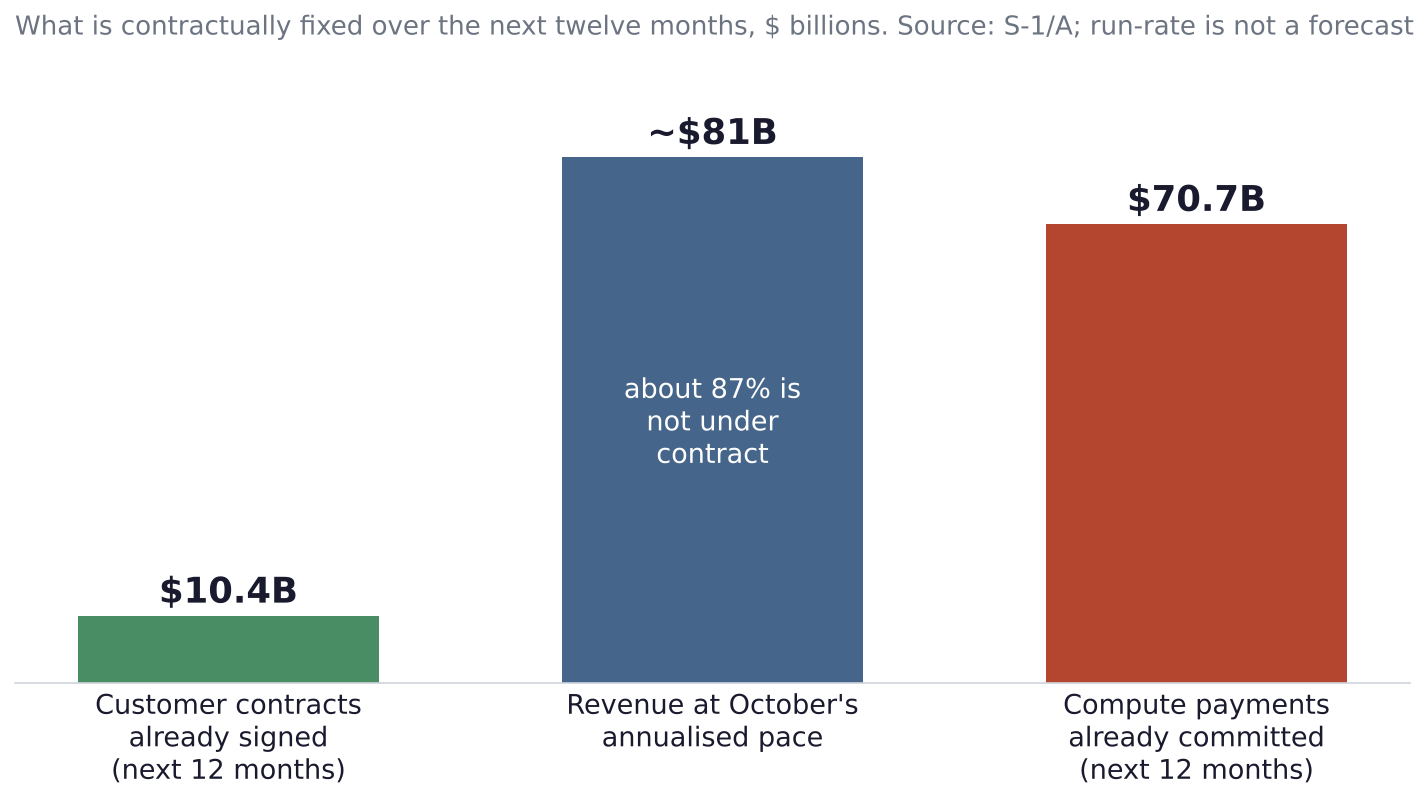
Customers have signed for $10.4B. Anthropic has signed for $70.7B of compute, 6.8 times as much. Source: [Anthropic S-1/A](https://www.sec.gov/Archives/edgar/data/2130357/000162828026074338/anthropicpbc-sx1ax3.htm). Chart by chokepoints.ai.Anthropic S-1/A. Chart by chokepoints.ai.*
Go deeper: 1.4 unit economics, 1.5 path to profit, 2.4 the compute bill, 2.5 cash
5 The terms favour sellers for the first six months
Anthropic built this deal to raise as much cash as it can. The new buyer gets a thin float, no vote and a lot of stock coming behind. The lock-up releases are the clearest known pressure on the shares before the first results.
Float: 6.3% of shares outstanding. Index funds will need about 28% of the shares on offer once the stock joins their indices.
Demand: orders cover the shares about seven times. Investors who expect to be cut back order more than they want.
Stock coming: insiders can sell up to 315 million shares from day one and 1.63 billion within 76 days, twice the IPO. Up to 1.7 billion more are freed two trading days after the first results.
Suppliers: seven suppliers buy $26.0B of shares with no lock-up. US resale rules hold those shares for six months.
Control: the founders hold 50.1% of the votes through one special share, and a trust elects most of the board.
Government: an appeals court upheld the Department of War's supply-chain label in September, and export rules switched two Claude models off in June. Anthropic's own court filings put the revenue at risk between under 2% and a mid-single-digit share.
Precedent: SpaceX priced at $135 in June, closed its first day at $160.95 and traded at $123.62 on 5 November.
Shares free to sell overtake the IPO within seven weeks
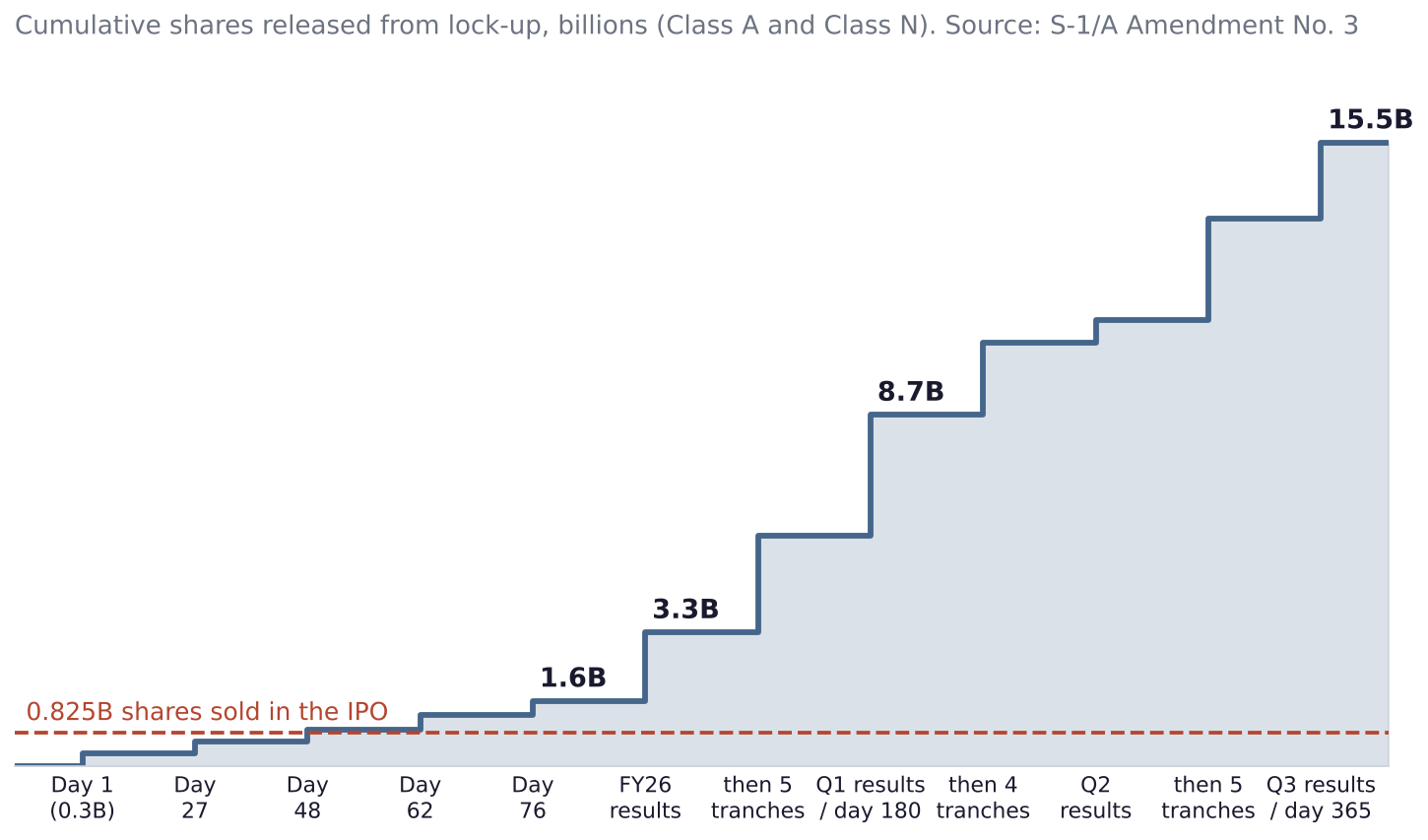
By day 76 the shares freed are twice the number sold in the IPO. After the first annual results they are four times. Source: [Anthropic S-1/A](https://www.sec.gov/Archives/edgar/data/2130357/000162828026074338/anthropicpbc-sx1ax3.htm) Amendment No. 3. Chart by chokepoints.ai.Anthropic S-1/A Amendment No. 3. Chart by chokepoints.ai.*
Go deeper: 2.6 control and rules, 3.2 deal structure, 3.3 lock-ups, 3.4 demand
6 What would change our view
We hold this view with low conviction, because it rests on growth that nobody can check until 2028. These are the things we will watch, and the seven numbers we will track each quarter.
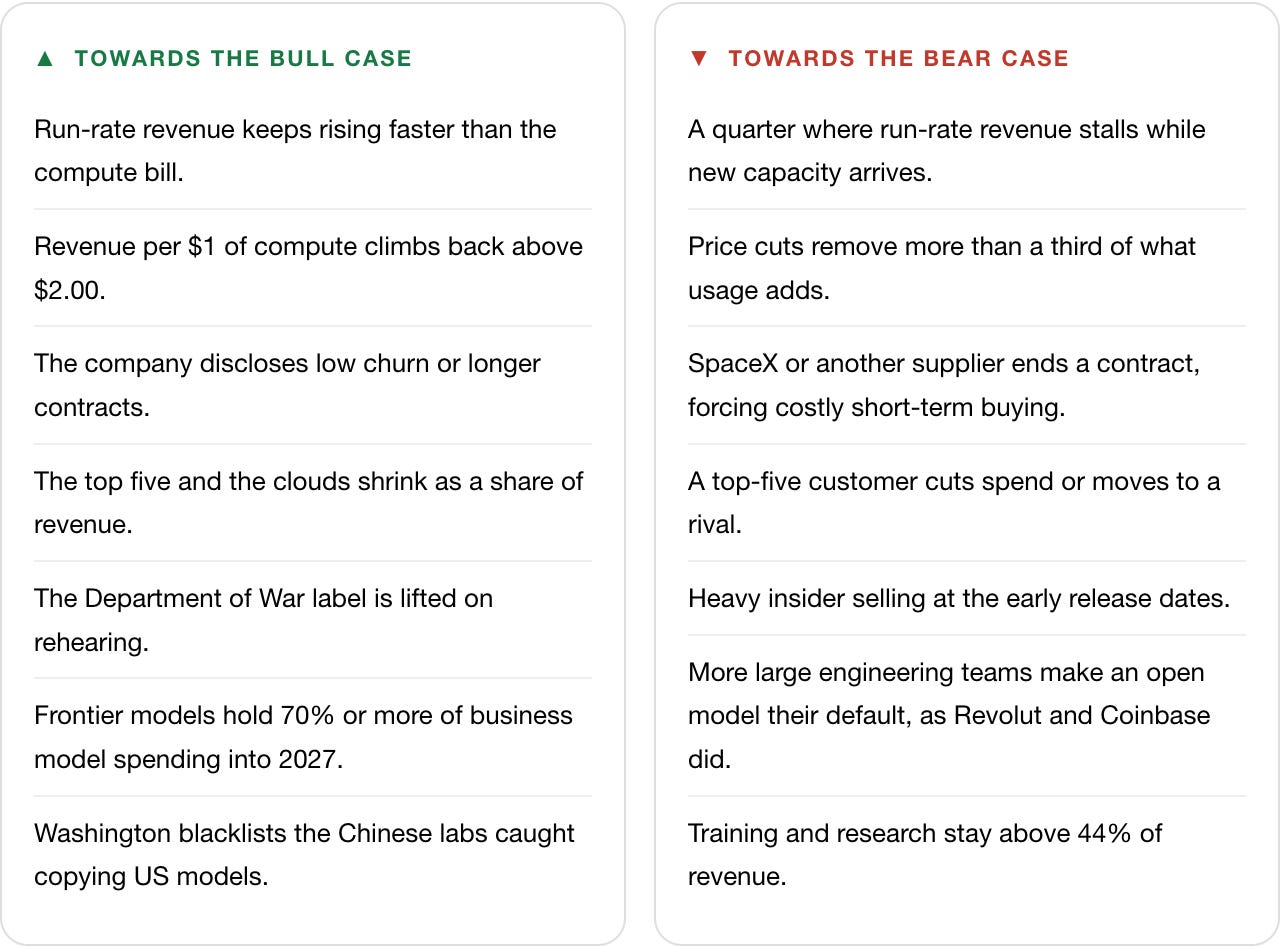
Seven numbers to track after listing
Run-rate revenue against compute due in the next twelve months: Today about $81B against $70.7B.
Revenue per $1 of compute: $1.72 in Q3; the target is $2.00 to $2.22.
Revenue under contract: $13.8B, about 13% of the run-rate for the year ahead.
Price cuts against usage growth: $0.6B against $6.0B in Q3.
Share of revenue from the top five customers and from the clouds: 21% in Q3 and 44% in the nine months.
Frontier models' share of business model spending: 69.5% in October on Ramp's data.
Compute that serves no paying customer, as a share of revenue: 44% in Q3; the 35% margin needs about 30%.
What this note does not cover
The final price: Anthropic had set no price as we published. Pricing is expected on 18 November, and our view covers $70 to $78.
New shares after the deal: our values use today's 17.5 billion shares. Stock pay of about $12B a year adds about 1% a year at $78, and suppliers' notes could add 4% to 5%. Over two years that takes about 6% off each value, and lifts the growth the range needs from about 27% to about 29%.
Copyright suits: Anthropic settled the authors' class action for $1.5B. Suits from music publishers, Sony Music Publishing and BMG among them, and from Reddit are pending, and the filing says statutory damages add to the risk. We have put no number on them.
People: the filing calls the chief executive and the president hard to replace. We have not assessed management, pay or staff retention.
Odds: we give a bear case of $29, a base of $78 and a bull of $137, and attach no probabilities to them.
Profit: we value Anthropic on sales and growth. We have built no cash-flow model, because the compute bill makes profit swing from quarter to quarter.
The wider AI market: we have not tested the view against a fall in AI shares. Nvidia's chief executive resigned on 12 November, and the two listed Chinese model labs fell about 90% from their peaks.
How to buy: we do not cover allocations, broker access outside the US or tax.
Part two: the deep dive
Eighteen questions, one by one. Every claim in the note comes from one of these sections, with the charts and sources behind it: https://www.chokepoints.ai/deepdives/anthropic
Not investment advice. For information and discussion only. It is not a personal recommendation, offer or solicitation. There is no public market in the shares yet, and the terms may change before pricing. The case values are arithmetic on our assumptions, not forecasts or price targets. Capital is at risk. Do your own work and consult a licensed adviser before acting.
Disclosure. We wrote this note with Claude, an AI model made by Anthropic, the company it covers. We checked filing figures against the SEC text. Where the note compares Claude with rival models, the scores come from independent testers and rivals' wins are listed beside Claude's. We have no position in Anthropic at the date of publication.
Read the full interactive atlas of the AI compute stack at chokepoints.ai.