

In 60 seconds
Powertech (PTI) does the last step in making a chip: it takes the finished silicon and packages and tests it so a computer can use it. It is Taiwan’s second-largest at that and the world’s fifth, and the leading specialist in packaging memory chips.
The AI twist is newer. The tightest bottleneck in an AI accelerator is no longer the transistors; it is the advanced packaging that wires the chip out to the rest of the system. TSMC’s version of that step, chip-on-wafer-on-substrate or CoWoS, is sold out and mostly goes to NVIDIA. Powertech is building a credible alternative on large panels, and AMD and Broadcom are reported (in trade press, not confirmed by either company) to be evaluating it, so it could work as an overflow valve for the AI demand TSMC cannot meet. Trade reporting puts that capacity booked through 2027, behind a record 2026 capital budget of about NT$50bn (US$1.6bn).
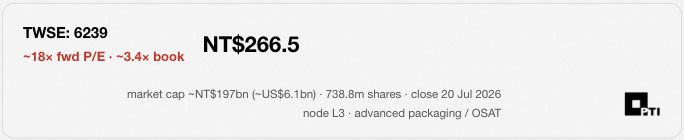
The market had paid for most of it, then gave a large piece back. Between 15 and 17 July the whole chip-equipment cohort de-rated on cycle-peak fears, and PTI fell with it: from NT$316.5 on 16 July to NT$266.5 by the 20 July close, about 31% below the NT$387 high and roughly 3.4 times its net asset value on an 11% return on equity. The question is no longer whether the chokepoint is real. It is whether enough has now come out of the price. Our answer: at NT$266.5, yes, in starter size. The selloff has put the price below every central value we compute, and inside the accumulate zone this note has carried since June.
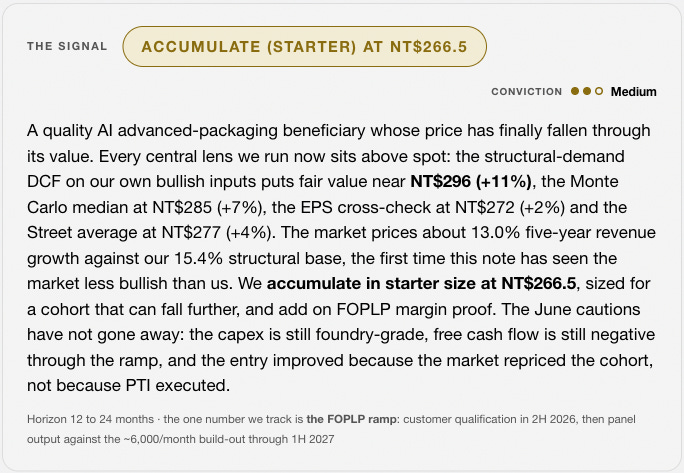
We run this newsletter on a structurally bullish view of the AI build-out. At the June price our hard test failed: even with our own worldview in the valuation, the price already paid for the ramp, and we said so. The cohort selloff has changed the arithmetic, and the same model that said avoid at NT$333.5 now says the market prices less growth than our own base case. The discipline that kept us out is the discipline that now puts us in.
01 Stack: the #2 memory OSAT, and a CoWoS overflow valve
A short primer. OSAT stands for outsourced semiconductor assembly and test. Chip designers design the silicon; foundries print the transistors; OSATs do everything after the wafer leaves the cleanroom. They cut the wafer into individual die, mount each die on a substrate or interposer, wire it up, encapsulate it, and run the burn-in and final test. The packaging step is increasingly where the value lives, because as transistors get smaller the bottleneck migrates upstream into how you wire a chip to the outside world.
PTI is Taiwan’s #2 OSAT and the world’s #5, with about 5.5% of the global OSAT market in 2024. It is the leading specialist in memory-IC packaging and test for DRAM and NAND, and its customer base is anchored by all three global DRAM leaders, Samsung, SK Hynix and Micron, who outsource portions of their memory packaging to it.
Two things to note about that customer mix. First, the DRAM leaders do not outsource everything; the highest-value memory packaging, particularly HBM stacking, stays largely in-house. PTI does not own the HBM TSV stack. Second, Micron acquired PTI’s Xi’an back-end facility in 2023 to internalise its China memory packaging. That cuts against a simple single-customer Micron-dependency story.
What is the chokepoint, then? Two of them. The first is conventional memory packaging, cyclical and competitive, riding the DRAM and NAND volumes of the AI server build-out. The second is the interesting one: advanced packaging for AI logic chips. When an AI accelerator needs to be packaged, die-on-interposer, with thousands of connections per mm², the dominant solution is TSMC’s CoWoS. CoWoS is sold out. It is the binding constraint on AI accelerator supply today. NVIDIA is the dominant customer; AMD, Broadcom and the custom-ASIC programmes form the queue behind it, and that non-NVIDIA queue is the natural overflow pool. Anyone building a credible alternative is, in effect, building an overflow valve. That is what PTI has done.
02 Technology: PiFO is a credible second source with no monopoly attached
The technology is the moat, so here is the technical bit. Fan-out wafer-level packaging embeds the die in a moulded wafer with redistribution layers, fine copper wiring that fans out from the die’s tiny contacts to larger package pads. Shorter interconnects, better electrical performance, lower cost at scale. Panel-level packaging (FOPLP) does the same on large square panels rather than circular 300mm wafers. The area-efficiency gain is enormous, but panel processing is hard; yields collapse if the panel warps, and only a handful of players are credible at it.
PiFO is PTI’s FOPLP architecture, with redistribution layers on both sides of the die. Trade reporting frames it as rivalling TSMC’s CoWoS-L; be precise about that. PiFO is a mould-compound panel fan-out, not a silicon interposer, so it is better read as a CoWoS-S/R-class alternative for AI-logic packages that do not need a large interposer, while the very largest accelerators stay on CoWoS-L. The distinction sets the runway: as flagship accelerators get bigger, more of the package volume migrates to CoWoS-L, the lane PiFO does not serve. Trade reporting put trial yields at 90% in September 2025 and at 95% by June 2026, with customer validation due in 2H 2026. Two caveats belong next to that figure: no broker source we have seen corroborates it independently, and a qualification yield on early product is not a volume yield; peer-reviewed work on large panels puts die-shift near 19 microns at the panel edge, which is exactly the failure mode that decides whether fine-pitch panel packaging survives mass production. The number that matters is sustained production yield at volume, and nobody outside the company has printed it.
On the demand side, the public reporting is that several major US AI chipmakers have turned to Powertech for the overflow, and that AMD and Broadcom back its FOPLP, with monthly FOPLP revenue targeted toward about NT$3bn. At announcement, in late 2025, that capacity was reported fully booked with demand near twice planned supply. The freshest broker channel checks, from spring 2026, are softer: clients adjusting quarterly orders, and FOPLP revenue estimates for 2026 and 2027 being trimmed. Booked is not the same as shipped, and the order book has already breathed once.
Three honest caveats. The AMD and Broadcom interest is reported, and brokers still class the datacenter engagements as market speculation rather than wins; the one confirmed AMD project is a console gaming APU, and Broadcom’s TPU packaging sits with TSMC and MediaTek. The order book is only partly visible; the full customer mix is undisclosed, so take it seriously but do not size it precisely. FOPLP is contested, not a monopoly: ASE is also expanding FOPLP capacity and TSMC has been preparing a CoPoS pilot line for 2026. PTI is one credible second source among several, which caps the long-run margin pool even as it leaves the next 18 months intact. And the HBM nuance matters: the HBM TSV and 3D-stacking process stays largely captive at the memory makers. The memory TSV and 3D-stacking packaging market is expected to grow from roughly US$2 to 3bn in 2024 toward US$10 to 15bn by 2028, but that growth accrues primarily inside the memory makers, not at PTI.
03 Numbers: the memory upcycle is already in the prints
The conventional half of the business is firing. Q4 2025 revenue was NT$21.41bn, up about 25.2% year on year, with net income of NT$1.86bn, up about 22.3%, its strongest quarter in three years. Q1 2026 sales were NT$21,314m, up about 37% year on year, with net income of NT$1,844m versus NT$1,175m a year earlier, up about 57%. April 2026 revenue reached NT$7.58bn, up about 32.5% year on year, and May followed at NT$7.92bn, up 30.2%. June came in at NT$7.62bn, up 21.7%, the sixth straight month in which the growth rate has come down: still a clean upcycle print, with the deceleration now impossible to ignore.
Be honest about the shape. Q1’26 net income (NT$1,844m) was essentially flat on Q4’25 (NT$1.86bn). The big year-on-year numbers are real, but they lap a weak 2025 base; this is a strong upcycle level; a sequential inflection has yet to show. The inflection the bulls need is the FOPLP ramp in the second half.
The context is a memory market in full upcycle. The HBM market is projected to grow from roughly US$35bn in 2025 toward US$45 to 55bn in 2026, with estimates varying by research house. PTI is a geared way to play that cycle without backing a single memory maker, because it packages and tests for all three. A reported dividend yield of about 2.6% is a modest cash return while the capex bet is in flight, and FOPLP spending could pressure even that if free cash flow stays negative through the ramp. The risk on this leg is duration, not direction: the prints are clean now, the question is how long the cycle holds in 2026.
04 Capex: a foundry-grade bet funded on OSAT earnings
This is where the hold gets uncomfortable. Management is putting real money behind PiFO: PTI raised its 2026 capex guidance to about NT$50bn (~US$1.6bn) in April 2026, up from an earlier NT$40bn plan and roughly double the prior year, primarily to expand FOPLP. Here is the number that should give a value-conscious investor pause. NT$50bn of capex against a revenue run-rate around NT$85 to 90bn is roughly 45 to 55% of revenue. That is at or above the top of foundry-grade capital intensity: across the recent build-out TSMC has run about 33 to 48% of revenue, peaking near 48% in 2022, and OSAT peers run 10 to 18%. PTI is spending like a leading-edge foundry on the earnings base of an OSAT.
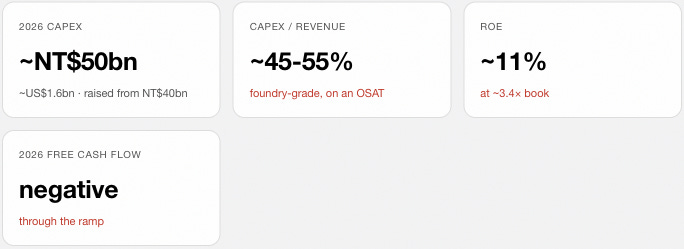
The new panel lines in Hsinchu, P11 plus P12 (a former AUO display fab acquired for NT$6.9bn), carry the build-out, with a target of about 6,000 panels per month. The timing needs stating precisely, because the market has at times traded this as a mid-2026 story: first-phase panel equipment arrives over the summer of 2026, the chairman puts customer qualification in the second half, and volume shipments start from 1H 2027, building through that year. FOPLP is a 2027 revenue story with a 2026 proof-of-life. A capex programme of this size at a company earning roughly NT$8 to 9bn a year in net income is a heavy lift: NT$50bn is close to six years of current net income in a single year. Free cash flow will be negative through the heavy ramp in 2026, and the gap has to be funded, by the balance sheet, by debt, or eventually by equity, none of which the bull case prices. The whole ROE bridge depends on that NT$50bn converting into revenue at FOPLP margins. If it converts, the spend buys a seat in the AI advanced-packaging pool. If it does not, it widens an asset base that still earns an OSAT return, and the multiple compresses.
05 Valuation: every lens lands below today’s price
PTI closed at NT$266.5 on 20 July 2026, a market capitalisation of about NT$197bn on 738.8m shares, still more than double its 52-week low of NT$116 but now about 31% below the all-time high near NT$387. The run up was a brutal re-rating, from pricing PTI as a memory OSAT to pricing it as an AI advanced-packaging capacity owner; the give-back has come in two legs, the late-June round trip (NT$387 to NT$311 and back above NT$330) and then the 15 to 17 July cohort selloff that took the whole chip-equipment complex down together. Book value per share is about NT$79, putting the stock at roughly 3.4× book on an ~11% ROE. That multiple still needs the capex bet to lift ROE materially. The difference is that the market is no longer paying for the answer in advance.
Our cross-check runs FY27E EPS against a justified exit multiple, discounted one year at 10%. These EPS figures are judgemental, a scenario frame rather than a bottom-up segment model, and the biggest swing factor is the exit multiple:
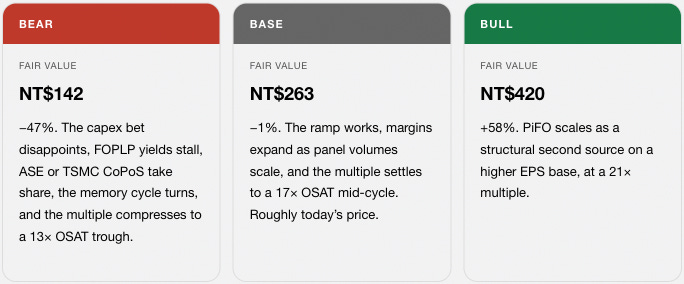
Prob-weighted at 25/50/25, the EPS-model target is about NT$272, now roughly 2% above spot; the cohort selloff has closed the gap this lens spent all of June flagging. If you believe PiFO earns a durable second-source re-rating and holds 28 to 30× on bull EPS, the upside tail is roughly NT$560 to 600; we exclude that from the headline because we do not think a panel fan-out second source holds a foundry multiple, but an honest reader should know the tail exists.
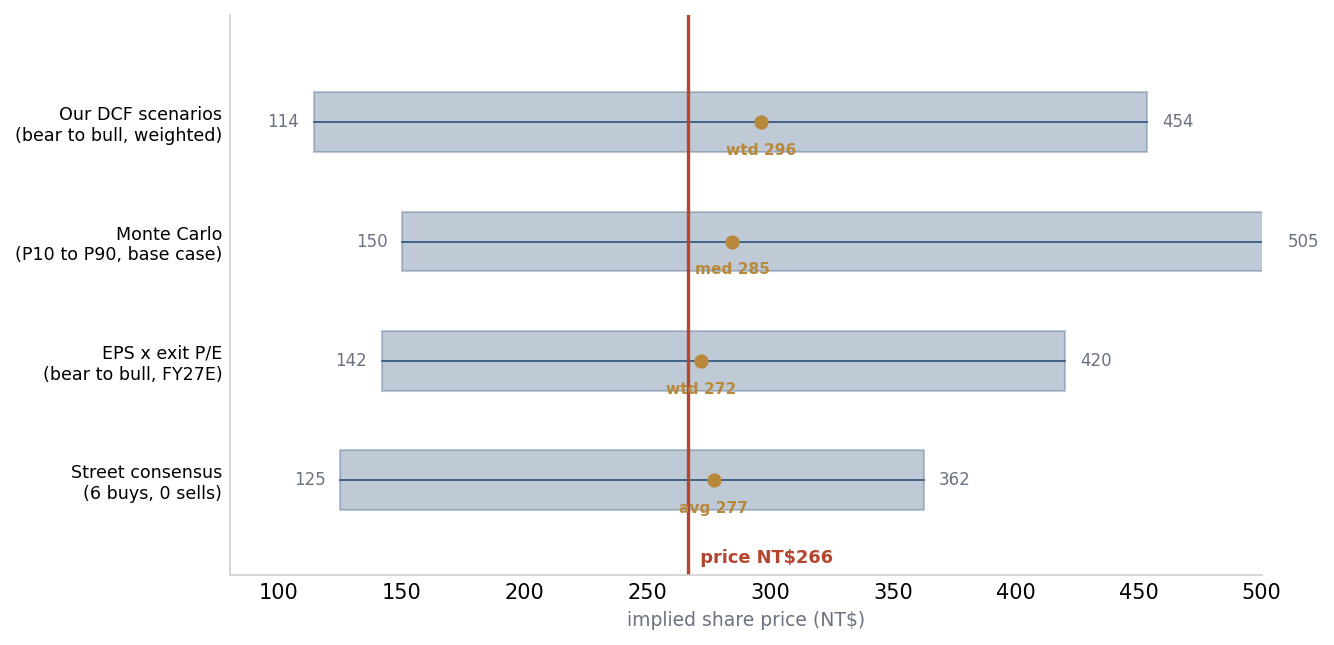
Implied share price by method. The central estimate of every lens, the worldview DCF (NT$296), the Monte Carlo median (NT$285), the EPS cross-check (NT$272) and the Street average (NT$277), now sits above the NT$266.5 close. Source: public market data and chokepoints.ai model, 20 Jul 2026 close. Chart by chokepoints.ai.
The Street picture has inverted with the price. Consensus targets range from about NT$125 to NT$362.5, average near NT$277, on 6 buy ratings and 0 sells, and at NT$266.5 the price now sits below the average for the first time since the re-rating began. Zero sells still means no downgrade cushion on a print miss. The difference is that a buyer here is no longer paying above what the Street itself thinks the shares are worth.
5b | Worldview: even our bullish DCF lands below spot
Here is the honest objection to everything above. We run on a structurally bullish view of the AI build-out, a front-loaded, decade-long trajectory rather than a cycle. Is the verdict just an artefact of conservative, mean-reverting assumptions? If we let our own worldview drive the numbers, what does PTI become?
We tested exactly that. Instead of an exit multiple, we built a multi-stage free-cash-flow model and put the worldview into the demand path: structural revenue growth, margins expanding as the FOPLP mix rises, and, crucially, capex modelled explicitly, gliding from roughly 55% of revenue in 2026 down toward 15% as the build-out matures. That is the right way to value a capex-heavy name. The bet is spend now, harvest the structural demand later, and a DCF is the only honest way to see whether it pays at NT$266.5.
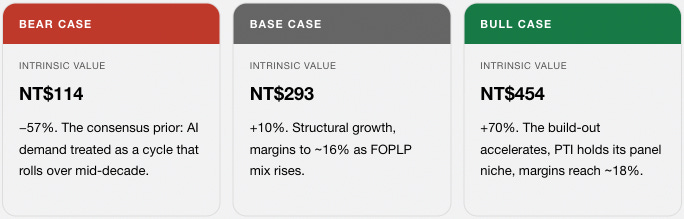
Weighting these 30/45/25, deliberately tilted toward our structural view, gives an intrinsic value of about NT$296, roughly 11% above spot. A Monte Carlo over the drivers (growth, margin, capex normalisation, discount rate) puts the median at about NT$285 and gives a 56% probability that intrinsic value clears today’s price, up from 36% at the June anchor.
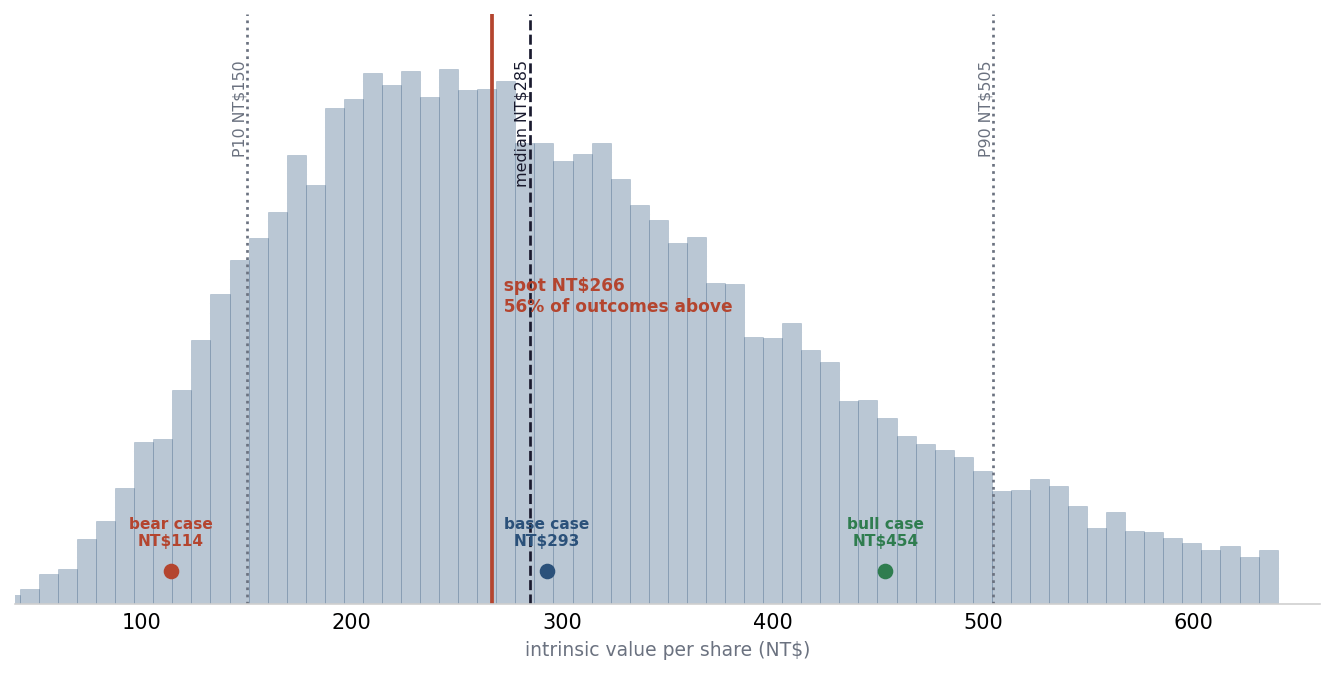
Monte Carlo over growth, terminal margin, capex normalisation and WACC on the base-case path. About 56% of outcomes clear NT$266.5. The market is pricing roughly a 13.0% five-year revenue CAGR, below our 15.4% structural base for the first time. Source: chokepoints.ai worldview DCF on public figures, 20 Jul 2026 close. Chart by chokepoints.ai.
Then the clincher, run in reverse. At NT$266.5 the market is pricing roughly a 13.0% five-year revenue CAGR, below our structural base-case path of about 15.4% for the first time in this note’s life. In mid-June, at NT$363.50, the market priced more growth than even our bullish base case; at the July peak-fear close it prices less growth than we ourselves underwrite. That inversion is the whole reason the verdict moves. The margin of safety is real but not lavish: 56% of Monte Carlo outcomes clear the price, the median sits 7% above it, and the name still burns cash for two years on foundry-grade capex while sharing the durable rent with a bigger overflow winner. That mix is what starter size is for.
06 Market tape: louder demand, a cheaper stock, a more crowded packaging race
A note is anchored to a moment, so we read the live tape for the memory cycle, the advanced-packaging race and PTI itself, and map each event to the call.
The demand leg, the part we called the free option, got distinctly louder. TrendForce has conventional DRAM contract prices rising 58% to 63% in Q2 2026 after a 93% to 98% jump in Q1, with NAND up as much as 75%, and Micron’s 24 June quarter printed record revenue of about $41.5bn, more than four times the year-earlier figure, at a record gross margin near 85%, a once-in-cycle print, with supply called tight into 2028. PTI is the number-two memory packaging and test house, and that volume is already in its prints: April 2026 revenue rose 32.5% year-on-year and Q1 sales about 37%. The conventional memory-OSAT business that does the work while FOPLP is the upside is geared straight to this, and a cycle called tight into 2028 lengthens its runway.
The competitive leg, which is where our bear case lives, got more crowded in the same window. TSMC is expanding CoWoS and SoIC hard and has a CoPoS panel-level pilot line completing around June 2026, with mass production targeted for 2028 to 2029; ASE is accelerating a 310mm fan-out panel line, PTI’s most direct competitor. Read together they set the clock precisely: PTI has roughly a two-year FOPLP window before TSMC’s panel-level packaging and a larger rival compete head-on, which is exactly the booked-through-2027, unproven-beyond-it risk in the bear column. The reported AMD and Broadcom interest is the bull’s answer, a reason PTI might hold a seat outside TSMC’s walled garden, but it rests on trade-press reports of evaluations, with no confirmed win, and it does not extend the window.
Then the tape broke, and not on anything PTI did. A rout in US semiconductor shares on 15 July spread through Asia; Tokyo Electron and Advantest each fell about 9% on 17 July as the Philadelphia index touched bear-market territory intraday, with global semiconductor market value down an estimated US$3.3tn from its 22 June peak. The proximate trigger was TSMC’s own 16 July print: a strong quarter with a raised 2026 capex guide, read by a nervous market as evidence the cycle had peaked rather than as good news. PTI fell from NT$316.5 on 16 July to NT$266.5 by the 20 July close, in line with its equipment-cohort neighbours and on no company-specific news; its own June revenue (NT$7.62bn, up 21.7%) had landed a week earlier, and on 17 July its board approved a US$400m joint venture with Broadcom in Singapore for fine-geometry redistribution-layer substrates, the first time the Broadcom relationship has appeared as a signed structure rather than a trade-press evaluation. A selloff that lands a company inside our accumulate zone in the same week its most-caveated customer story hardens is the setup this note was built to catch. Three cautions keep the enthusiasm honest.
The HBM stack is not PTI’s to package. The biggest memory dollars sit in HBM, and the HBM stack stays captive at the memory makers. PTI benefits through conventional memory packaging and test and the broader logic-packaging pull; the HBM stack itself passes it by, so the loudest part of the cycle flows to it the least.
The second-source race tightened inside a fortnight. Trade reporting on 25 June has ASE’s automated FOPLP line targeting mass production by the end of 2026, against PTI’s qualification-then-1H27 schedule, roughly two quarters ahead; on 18 June TSMC and Amkor signed a definitive ten-year Arizona packaging agreement; and on 1 July ASE raised CoWoS and FoCoS quotes by more than 20%. Overflow pricing power is real and being printed, but the bigger rivals are monetising it first, and broker research now scores ASE and Amkor as the winners of the high-end overflow race while PTI’s lane runs through ASICs, CPUs and memory-adjacent work. One offset runs the other way: mid-June checks have TSMC’s CoPoS slipping, with volume production now unlikely before 2029 to 2030, which lengthens the panel window for everyone already standing in it.
A cyclical tailwind is not the structural re-rating. The free option getting louder does not prove the FOPLP capex bet works; that is still PTI’s own execution, the qualification-and-ramp schedule we track at the end. A peak keeps the prints strong for a few quarters. It is no reason to pay past our margin of safety below about NT$285.
The tape has now done what we asked of it: the price crossed our accumulate line, and the demand half of the call strengthened while it happened. The durability half is still open, and the print that moves our number next is PTI’s own second-quarter result, due in late July, where what matters is whether the FOPLP mix lifts margins toward the high teens. Another revenue beat on its own tells us little.
07 Both sides: the price is paying for the bull
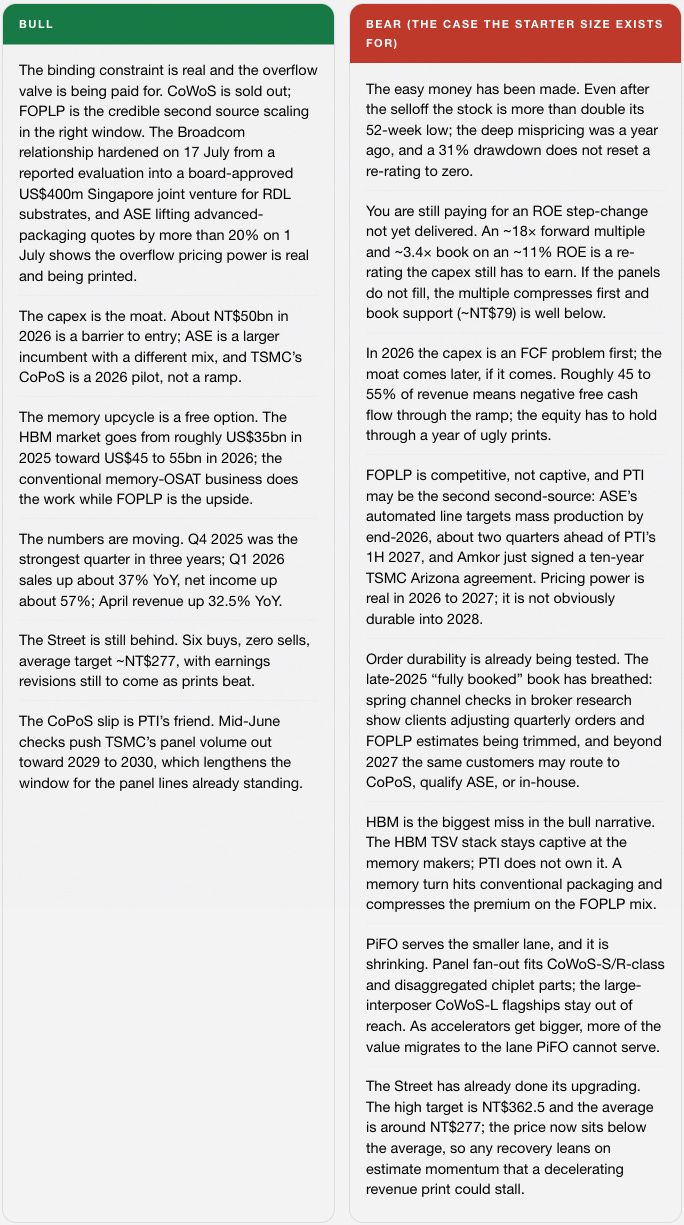
Both halves are real. The whole call is which half the price is paying for, and at NT$266.5 it no longer fully pays for either: the price sits below the base case on every lens we run. That is what an entry looks like.
08 Scorecard
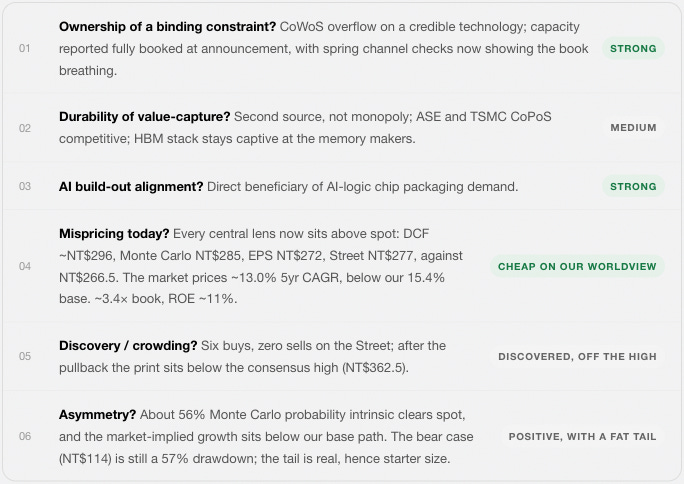
Best-in-class AI advanced-packaging beneficiary, and the chokepoint survives scrutiny. For the first time since we opened coverage, the value leads the price: the cohort selloff has delivered the entry the June note said to wait for. We accumulate in starter size at NT$266.5 and add on P11 margin proof, sized for the NT$114 bear tail that has not gone anywhere.
09 Triggers: what would move us to buy or sell
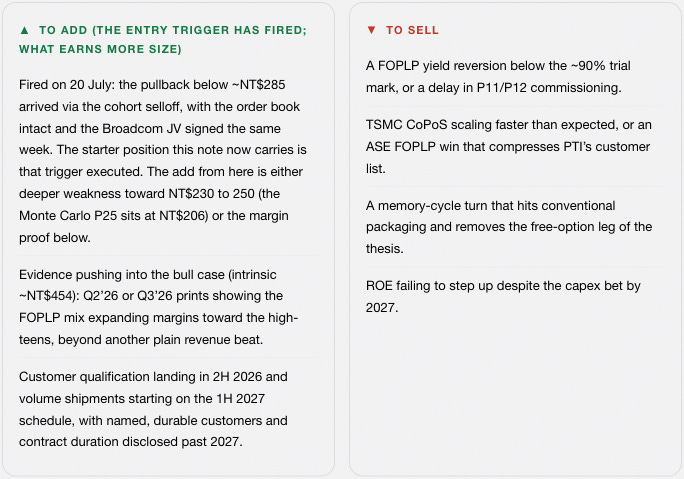
10 The one number: the FOPLP ramp, qualification in 2H26, volume from 1H27
The FOPLP ramp: customer qualification in 2H 2026, then monthly panel output against the ~6,000-panel build-out through 1H 2027. We are precise here because the tape has not been: first-phase panel equipment arrives this summer, qualification is a second-half event, and volume is a 2027 event, so a mid-2026 “ramp” headline in either direction is noise. This schedule is the cleanest proof point that the capex bet is converting into capacity and that the CoWoS overflow thesis has physical inventory behind it. If qualification lands in 2H 2026 and output scales on the 1H 2027 schedule, the bull case is intact and the starter position earns its adds. If it slips, the multiple starts to look foolish, and ASE will be shipping panels first; the position is sized so that outcome hurts rather than wounds. The accumulate line we spent June waiting for is the price on the screen.
Step back once before the desk section, because the shape of this trade is the shape of the whole build-out. On our worldview the binding constraint keeps migrating down the stack: transistors were the chokepoint until 2024, CoWoS packaging is the chokepoint now, and the next squeeze is already visible in panel formats, HBM test intensity and, from late 2027, hybrid bonding. Each migration re-prices a new layer, and each opens a window for whoever built capacity just before the constraint arrived. PTI is a bet on exactly one of those windows. Windows are real money, but they are rented, not owned: the durable rent lands with whoever holds the qualified interface when the constraint moves again, which is why the equipment and materials one layer further down (the moulding presses, the substrates, the glass cores) keep showing up as the better chokepoints in this series. Pay for a window only at a price that does not need the window to last. That is the whole discipline behind the NT$272 to NT$285 line, and the 20 July close is the first print inside it.
11 If you want to trade it: expressions, not chases
The verdict above is the position: the bid we advertised at NT$272 to NT$285 has been filled from below, and the book expression is a starter long at NT$266.5. For readers who run books rather than watchlists, our desk pass (computed 2 July; the tape has moved, the structure of each idea has not) turned up expressions worth testing, with the numbers computed deterministically from the tape (realised volatility, pair z-scores, betas), not eyeballed. Treat them as ideas to test, never recommendations, and size for a stock whose 30-day realised volatility was running near 91% before the cohort selloff added to it. There are no listed options on this line, so every expression is cash equity.
The core expression is the starter long, with the adds pre-committed. Own it at NT$266.5, add toward NT$230 to 250 on further cohort weakness or on FOPLP margin proof, and trim back into the NT$333.5 to NT$362.5 zone where every lens again sits below price. The reference levels: DCF-weighted NT$296, Monte Carlo median NT$285, Street average NT$277, all above spot. Risk: the bear case is NT$114; a memory-cycle turn plus a FOPLP slip gets there, which is why the starter is a starter.
The relative trade, long TSMC short PTI, has had its reset. TSMC’s 16 July print (strong, higher capex guide) was the event the 2 July desk pass said to wait through, and the cohort selloff has since moved the spread violently in the short leg’s favour. With PTI now below every central lens we compute, the risk-reward of being short it against TSMC is gone; we retire the idea rather than update it. Risk: none retired ideas carry; the note is flat the pair.
The statistical anomaly we are NOT taking. PTI versus ASE screens at a weekly z-score of −2.41, PTI cheap against its own history with its closest rival, which mechanically argues long-PTI short-ASE. We decline it, and the reason is the point: the fundamentals just moved against the statistics. ASE’s panel line targets volume two quarters ahead of PTI’s and it is already printing 20%-plus price rises, so some of that spread is a re-rating that deserves to stick, not noise that mean-reverts. When the quant signal and the second-source race disagree, the race wins.
The patience play is a real position. PTI’s own second-quarter date is not yet confirmed, and its expected earnings-day move has historically been small (about 1.6% mean absolute over the last eight prints) against a 91-vol tape, so the event is not the edge. Cash, plus the alerts below, is the fourth expression.
For good order: none of this is investment advice, and the desk numbers above are the publisher’s own calculations from public price data.
12 Dates to watch
The late-July calendar is dense, and almost all of it is other people’s prints that read through to PTI. Dates are source-traced; PTI’s own results date was unconfirmed at publication.
10 July, landed : June monthly sales printed NT$7.62bn, up 21.7%, the sixth consecutive deceleration. The 10 August July print shows whether the rate stabilises.
16 July, landed : TSMC’s second-quarter beat with a raised capex guide was read as cycle-peak evidence and set off the cohort selloff that delivered our entry. CoWoS commentary stays the overflow complex’s metronome.
27 July : Amkor second-quarter results. The US OSAT read-across, now carrying the ten-year TSMC Arizona agreement.
30 July : ASE second-quarter results. The single most important cross-read: the rival panel line’s ramp commentary and whether the 20%-plus quote rises are holding.
Late July, unconfirmed : PTI second-quarter results, the margin print our number waits on.
23 September : Micron FQ1 results. The memory-cycle read for the conventional half of the business.
One layer further out, the schedule that decides the thesis: FOPLP customer qualification in 2H 2026, volume shipments from 1H 2027, ASE’s rival line at end-2026, and TSMC’s CoPoS now checking toward 2029 to 2030. The window is long enough to pay the patient and short enough to punish the late.
13 Go deeper
The public sources behind this note, if you want to take the thesis apart yourself. Each opens in a new tab.
The thesis: CoWoS overflow to Powertech.
TrendForce: TSMC CoWoS crunch pushes US AI chipmakers to Powertech through 2027, the core overflow-valve report.
Taipei Times: Powertech board approves US$400m Broadcom joint venture in Singapore, the customer story turning into a signed structure, 17 July 2026.
TrendForce: AMD Zen 7 with Powertech FOPLP reportedly under evaluation, the AMD customer signal.
TrendForce: ASE targets FOPLP mass production by end-2026, the rival line running two quarters ahead.
TrendForce: ASE raises advanced-packaging quotes by more than 20%, overflow pricing power, printed.
Taipei Times: chairman Tsai on the FOPLP schedule, qualification 2H26, shipments from 2027, from the company itself.
The technology and the competition.
TrendForce: FOPLP heats up, ASE and Powertech expand, TSMC preps a 2026 CoPoS pilot, the case that this is a second source with no monopoly.
TrendForce: FOPLP trial yields reportedly reach 90% at Powertech, the yield question that decides the ramp.
The capex bet and the roadmap.
DigiTimes: Powertech lifts capex to US$1.6bn for AI packaging, the April 2026 guidance raise.
DigiTimes: AMD and Broadcom back Powertech’s FOPLP; monthly revenue toward NT$3bn, the named backers.
DigiTimes: Powertech secures full FOPLP bookings ahead of its expansion, the P11 6,000 panels/month target.
DigiTimes: Powertech to accelerate FOPLP, mass production targeted 1H27, the P12 roadmap.
The company, the cycle and the worldview.
Yahoo Finance: Powertech (6239.TW), live price, valuation and financials.
Taipei Times: Micron’s acquisition of Powertech’s Xi’an plant, the 2023 Xi’an transfer.
Situational Awareness (Leopold Aschenbrenner), the structural AI-build-out worldview this note reasons from.
Not investment advice. For information and discussion only, and not a personal recommendation, offer or solicitation. Capital is at risk, and investments can fall as well as rise. The scenario fair values and price targets here are the publisher’s estimates, not a forecast or a guarantee. Do your own work.
All figures come from Powertech’s public disclosures, peer public market data, and the publisher’s own calculations. No third-party research is quoted or reproduced. Sources: Situational Awareness; Powertech public disclosures; chokepoints.ai scenario and DCF work. © 2026 chokepoints.ai, Issue 004, Powertech sits at the advanced-packaging layer of the AI chokepoints map. All issues
Read the full interactive atlas of the AI compute stack at chokepoints.ai.