

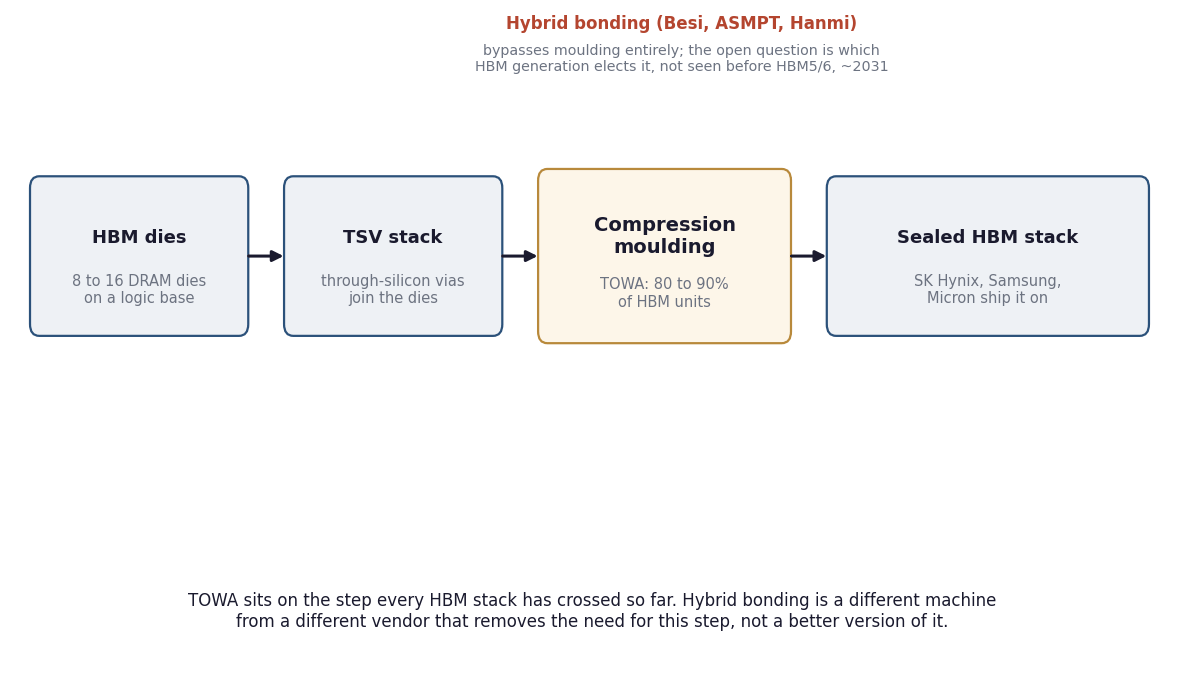
Compression moulding seals the finished stack in epoxy; a hybrid-bonded stack still gets encapsulated, but the job shrinks and moves away from the moulding press TOWA sells. Source: facts-public.json and TOWA IR; schematic by chokepoints.ai, 21 Jul 2026.
In 60 seconds
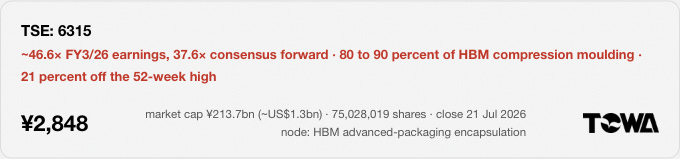
Eight or nine of every ten HBM stacks are sealed in their epoxy shell on a TOWA press. Compression moulding is the step, TOWA is the default supplier, and the AI build-out pulls the tool directly. That much is not in dispute. Between 15 and 17 July the shares fell 17.9 percent in two sessions to ¥2,791, as the whole Japanese chip-equipment cohort de-rated together; Tokyo Electron fell 9 percent and Advantest 9.4 percent the same week on fears that AI capital spending has peaked. Nothing TOWA-specific caused it. The stock has since recovered part of the move, to ¥2,848.
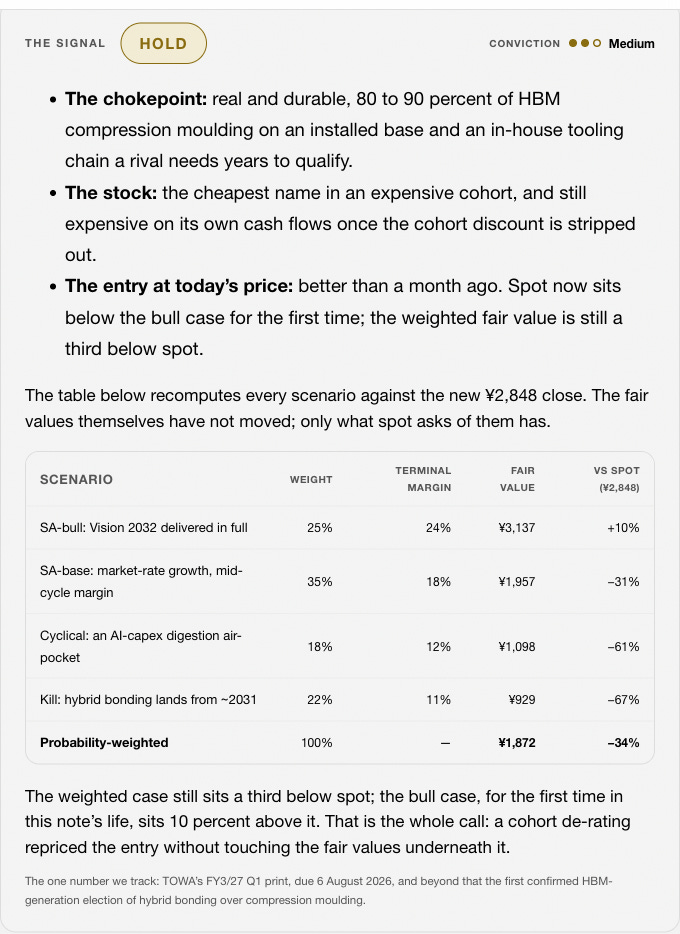
At that price the gap between what the market pays and what we can defend has narrowed but not closed. A reverse-DCF says the tape still prices about 17.2 percent revenue growth a year for five years; our defensible base is 8.8 percent, and even management’s own plan delivered in full runs at about 12.8 percent on revenue. Close that gap and the weighted fair value sits 34 percent below spot, though for the first time the bull case, management’s own Vision 2032 plan executed in full, now clears spot rather than falling just short of it. We hold the chokepoint and wait for a better price.
Playing devil’s advocate
The strongest case against us says the correction did the valuation work already: a stock that fell 21 percent from its high in a week is no longer priced for perfection, and buying chokepoints into a sector panic is usually the trade. We grant the premise. The cohort-wide fall is exactly the kind of indiscriminate selling that creates entries in names whose fundamentals never changed, and TOWA’s own order book, per the May 2026 results call, was running at a record for compression-mould dies on AI data-centre demand. The arithmetic still answers the case: even after a 21 percent drawdown, the weighted fair value is ¥1,872, a third below the new spot, and the market-implied growth rate of 17.2 percent a year is still double our 8.8 percent base and above the 7 to 8 percent the moulding-equipment market itself compounds at. A cheaper multiple is not the same as a cheap stock when the cash flows have not moved. The correction closed part of the gap. It did not close it.
01 TOWA owns the seal every HBM stack needs before it ships
A finished HBM stack is eight to sixteen DRAM dies threaded with through-silicon vias on a logic base, and it cannot survive board assembly unmoulded. Compression moulding wraps the stack in a thermoset epoxy shell that protects it mechanically, blocks moisture, helps move heat and leaves a flat surface for the next step. JEDEC has already lifted the HBM4 module-height limit from 720 to 775 micrometres and is weighing a move toward roughly 900 for HBM4E; the compound has to flow into a taller stack, encapsulate the connections, and cure without a void, a bow or a cracked die. Transfer moulding, the older process, cannot do this reliably at that height. Compression moulding can, and TOWA holds 80 to 90 percent of the units doing it.
The moat is switching cost, not a patent wall. TOWA makes its own moulds by electroforming, a process that duplicates a mould in about a day, not weeks of machining; its BANCERA coating cuts release force and cleaning frequency; its CBN end mills finish pockets to a few nanometres of roughness. A rival would need years to qualify an equivalent chain at a memory maker. That defence protects a step for as long as the step exists, which is the subject of section 05. The schematic at the top of this note lays out the full chain: dies, TSV, the moulding step TOWA owns, and the dashed hybrid-bonding bypass that section 05 covers in full.
02 A focused tool-maker with a record order book going into the print
TOWA is a Kyoto tool-maker founded in 1979, built almost entirely on one process it won early: transfer moulding first, then compression moulding as packages shrank and stacks grew taller. Semiconductor Manufacturing Equipment is the business; Medical Device and Laser Processing are minor arms. Leadership passed cleanly in April 2025, Hirokazu Okada to Chairman and CEO, Muneo Miura to President. It is a razor-and-blade model: systems (compression and transfer moulding presses, the LGS1040 laser singulation platform) are lumpy and cyclical, an advanced compression system running upwards of US$1.5m a unit against management’s guide of 30 to 45 HBM-related systems a year; the aftermarket (precision moulds, BANCERA coatings, release films, field service) carries higher margins and renews on a cadence that outlives any single order cycle.
The fiscal year ended March 2026 was the trough for margins and the record for orders at the same time: sales grew 1.7 percent while operating profit fell, but AI data-centre demand pushed compression-mould die orders to a record and management guides FY3/27 sales up 17 percent. The company also introduced INNOMOS, a next-generation compression system claiming roughly half the mass-production cost and double the productivity of older lines, positioned as the mechanism for the Vision 2032 margin target. None of this is the cause of July’s fall; TOWA’s own next print, Q1 FY3/27, is not due until 6 August 2026. The order book going into that print is the strongest evidence the bull case has for durability; the trough margin is the strongest evidence against it, and section 04 takes both in turn.
03 The 15 to 17 July fall was a cohort de-rating that TOWA rode down
TOWA fell 6.9 percent on 16 July to ¥3,165, then a further 11.8 percent on 17 July to ¥2,791, a two-session fall of 17.9 percent, before recovering to ¥2,848 on 21 July. No TOWA-specific news explains it. What explains it is a sector-wide repricing of AI-capital-spending risk that hit the entire Japanese chip-equipment cohort at once. A rout in US semiconductor shares on 15 July, Micron falling on intensifying competition fears from Chinese memory makers, dragged the Philadelphia Semiconductor Index sharply lower and pulled South Korea’s KOSPI down more than 7 percent intraday. Tokyo followed on 16 July: the Nikkei 225 reversed 1,916 points, with Advantest the single biggest drag on the index. The rout deepened on 17 July, when the Nikkei fell further and the Philadelphia index touched bear-market territory intraday, more than 20 percent below its June peak, before paring the fall by the close; Tokyo Electron fell about 9 percent and Advantest about 9.4 percent that day alone. Two forces compounded the move: TSMC had just raised its 2026 capital-spending guidance, and the market read a strong print with a higher guide as evidence the cycle had already peaked; separately, a new model from the Chinese AI lab Moonshot narrowed the perceived gap with the leading US labs, reviving doubts about how much compute the buildout still needs. Global semiconductor market value fell by an estimated US$3.3tn from its 22 June peak. TOWA fell harder than the megacaps, 17.9 percent over two sessions against single-day falls of about 9 percent at Tokyo Electron and Advantest, which is what a ¥214bn small-cap’s beta does inside a cohort selloff; Hanmi, its closest small-cap comparator in the HBM tool chain, fell a similar 17 percent over the same fortnight.
Hanmi’s fall came on the same cohort-wide repricing, with no bad news of its own either. It is the clean test of the sector-beta read. A company-specific shock would have hit TOWA and spared its neighbours; instead the whole cohort, moulding and bonding vendors alike, fell together. This matters for the call: a fundamental shock would force us to re-underwrite the fair values in the table above. A multiple compression that leaves the cash flows untouched does the opposite; it makes the entry better without changing what TOWA is worth. If the peak-capex read behind the selloff proves right, it reaches TOWA through the FY3/27 guide, and the Cyclical case (¥1,098, weighted 18 percent) is where the model already prices it; the 6 August print is the first test.
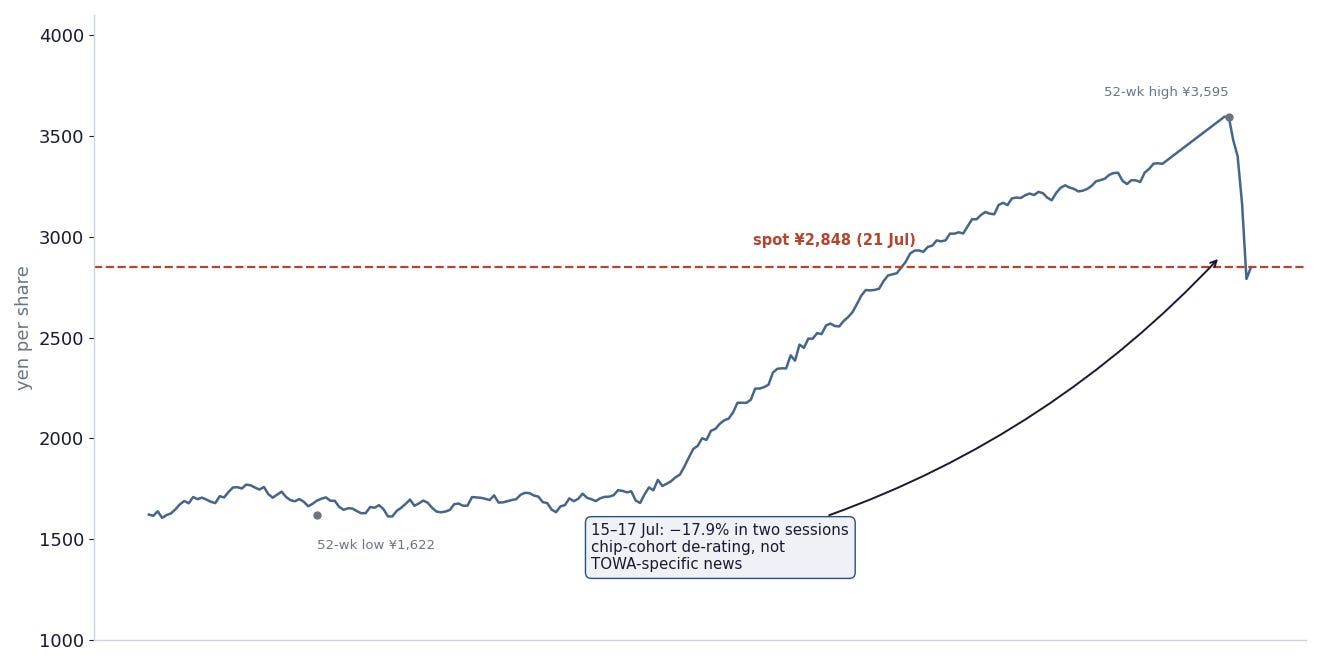
The 52-week range and the four confirmed July closes are the only exact points; the path between them is illustrative. Source: facts-public.json (52-week range) and desk-verified yfinance closes, 21 Jul 2026.
04 The margin bet is the same bet it was, just at a lower entry
TOWA’s profitability is the swing factor in its own valuation. FY3/26 was a trough: the trailing net margin compressed to 8.4 percent from 15.2 percent, against an FY3/25 that earned a 16.6 percent operating margin on ¥53.47bn of sales. Vision 2032 targets ¥100bn of sales at a 25 percent operating margin, with a guided recovery toward 16 percent as soon as FY27. The distance between an 8.4 percent trough and a 25 percent target is the distance the bull case has to travel, and INNOMOS is management’s named mechanism for travelling it, not evidence it already has.
The workforce shape is the quiet tension underneath the plan. TOWA runs about 2,099 consolidated staff at March 2025, rising toward 2,211 a year later, 1,906 of them in semiconductors, average age 39.5 and average tenure 11.3 years. That depth is precisely what a chokepoint needs to defend a step against qualification by a rival. It is also a thin base from which to deliver a near-doubling of revenue at a record margin while standing up INNOMOS and adjacent product lines. The bull case in the signal box, a 24 percent terminal margin, sits just under the 25 percent Vision 2032 target; it assumes the plan lands close to as written.
05 Hybrid bonding is the expiry date the price still does not carry
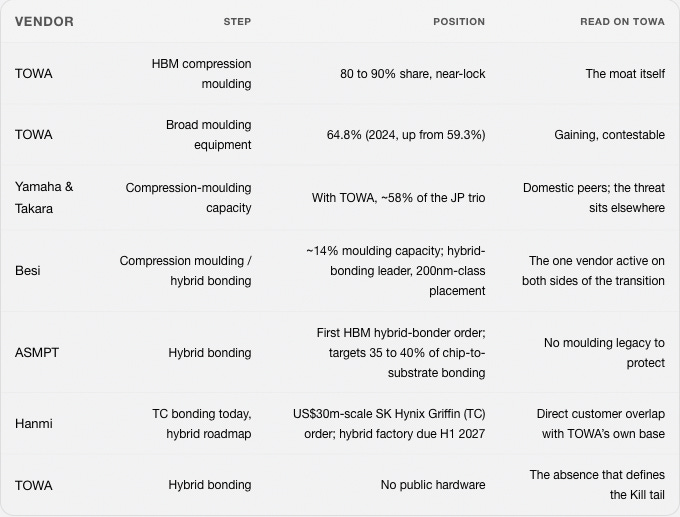
Every defence in section 01 protects a step that could stop existing, and the market has priced that risk as remote instead of merely deferred. Hybrid bonding joins dies copper-to-copper with no bump and no gap to underfill, and a stack bonded that way needs a smaller, different encapsulation job. TOWA has no public hybrid-bonding hardware. Besi leads the field with 200-nanometre placement accuracy at three sigma; ASMPT has taken its first HBM hybrid-bonder order and targets 35 to 40 percent of chip-to-substrate bonding; Hanmi has taken a US$30m-scale SK Hynix order for its Griffin thermocompression line, a bonder win rather than a hybrid one, and has its own hybrid bonder on a roadmap with a dedicated factory due in H1 2027. A step that evolves rewards TOWA’s installed base. A step that is removed hands the work to a different machine from a different vendor, and TOWA has no seat at that table.
The saving grace is timing. SK Hynix has said it will keep MR-MUF while it refines hybrid bonding, and all three memory makers are expected to stay on microbump-plus-underfill through HBM4. The threat most likely arrives at HBM5 or HBM6, perhaps from around 2031, with no published date. Nothing in the news sweep behind this re-anchor changes that picture: no maker has announced an election either way since the prior anchor. The Kill case prices the full chain: a memory maker elects hybrid bonding at HBM5 or HBM6, new lines carry no moulding step to sell into, systems demand decays toward the aftermarket, the terminal operating margin settles near 11 percent, and fair value lands at ¥929, the bottom line of the scenario table. It carries a 22 percent weight because it is deferred, and it is the one line this note will not soften on a price move alone.
06 A short customer list is pricing power and hostage risk at once
Downstream, the customer pyramid is short: an OSAT layer led by ASE (44.6 percent of a top-ten that turned over US$41.56bn in 2024), and a memory layer of SK Hynix, Samsung and Micron, with SK Hynix holding the majority of HBM. TOWA sits on consortia that write the standards, one of 27 members of Resonac’s JOINT3 panel-level group and a member of the US-JOINT advanced-packaging consortium launched in April 2026. SK Hynix’s ¥19 trillion packaging-and-test build at Cheongju, due around end-2027, is a direct downstream pull on the tool line. That concentration is why TOWA can charge what it charges, and why the next order pause, with 88.4 percent of sales overseas, will originate abroad and arrive without much warning; the 15 to 17 July fall shows what that kind of surprise looks like when it arrives market-wide.
Upstream the risk is mild: the bought-in content of a press is standard industrial automation from Yaskawa, Mitsubishi, FANUC and Nidec, and the epoxy moulding compound comes from a plural field led by Sumitomo Bakelite. No single supplier can hold TOWA to ransom; compound pricing is simply one channel into the margin story in section 04.
07 TOWA owns the narrow step almost outright and competes for the rest
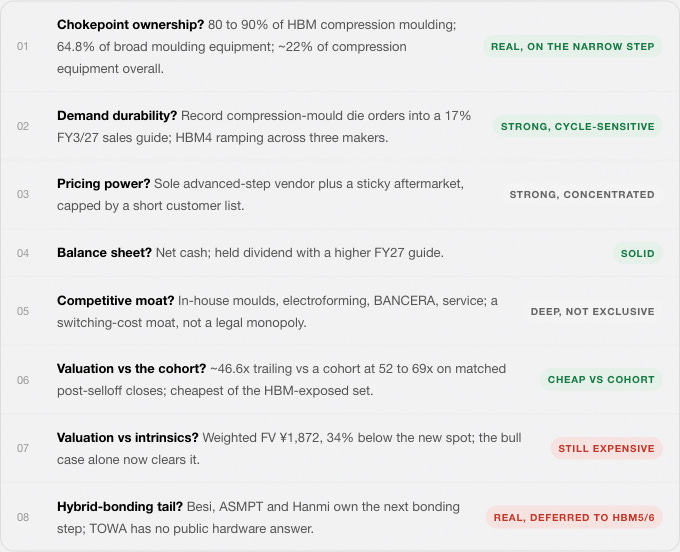
The near-monopoly label is correct only on the narrowest of three markets. TOWA holds 80 to 90 percent of HBM compression moulding, a genuine near-lock; 64.8 percent of the broader moulding-equipment market in 2024, up from 59.3 percent, still gaining but plainly contestable; and roughly 22 percent of compression-moulding equipment of every kind, not dominance at all. The Japanese trio of TOWA, Yamaha and Takara holds about 58 percent of compression-moulding capacity between them, with Besi near 14 percent. Flattening these three numbers into one figure is the single most common error in the bullish telling.
08 Four risks sit ahead of everything else in this note
The hybrid-bonding tail. Besi, ASMPT and Hanmi own the technology that could end the franchise; TOWA has no product answer if a memory maker elects it at HBM5 or HBM6.
A cohort-wide de-rating with no cushion. TOWA’s relative cheapness inside its cohort is no defence against the cohort re-rating together, which is what just happened and could happen again.
A margin plan that is still a guide. Vision 2032 and INNOMOS are the mechanism management names; the FY3/27 Q1 print on 6 August is the first hard evidence either is landing.
Customer-calendar concentration. SK Hynix, Samsung and Micron set the order book between them, and 88.4 percent of sales sit overseas with a currency exposure attached.
09 The new price still asks for growth well above the moulding market
Two lenses value TOWA and they still point in opposite directions. On the relative lens, the selloff compressed the whole cohort, so the comparison below uses one consistent basis: trailing multiples at the 17 July post-selloff closes, all from the same pull. The AI-equipment names now sit in a tight band, Tokyo Electron and Disco at 52.1 times, Advantest at 53.5, Kokusai at 68.5, with SCREEN, the broad-equipment bracket, at 33.9. TOWA at ¥2,848 pays 46.6 times its FY3/26 earnings of ¥61.1 a share, or 37.6 times consensus forward earnings of ¥75.70: still the cheapest of the HBM-exposed set, though by a narrower margin than the pre-selloff numbers suggested. Applied to TOWA’s trailing earnings, the cohort multiples imply ¥3,184 to ¥4,187; SCREEN’s implies ¥2,072. The relative lens still brackets spot from above.
The intrinsic lens is ours. A reverse-DCF, run at the new ¥2,848 close on the same public spine as the prior anchor (launch revenue ¥54.37bn, WACC 9.0 percent, terminal growth 2.0 percent, ¥20bn of net cash added to enterprise value), backs out market-implied growth of about 17.2 percent revenue a year for five years, down from 19.1 percent at the old anchor but still double our defensible base of 8.8 percent and above the moulding-equipment market’s own 7 to 8 percent CAGR. The bull case’s own revenue path, the one that assumes Vision 2032 lands, runs at about 12.8 percent, itself below what the market prices in; the bull case only reaches ¥3,137 through a 24 percent terminal margin, not through faster growth than the market already assumes. This is the sharpest way to see the gap: even crediting management’s full plan on revenue, the market still wants more.
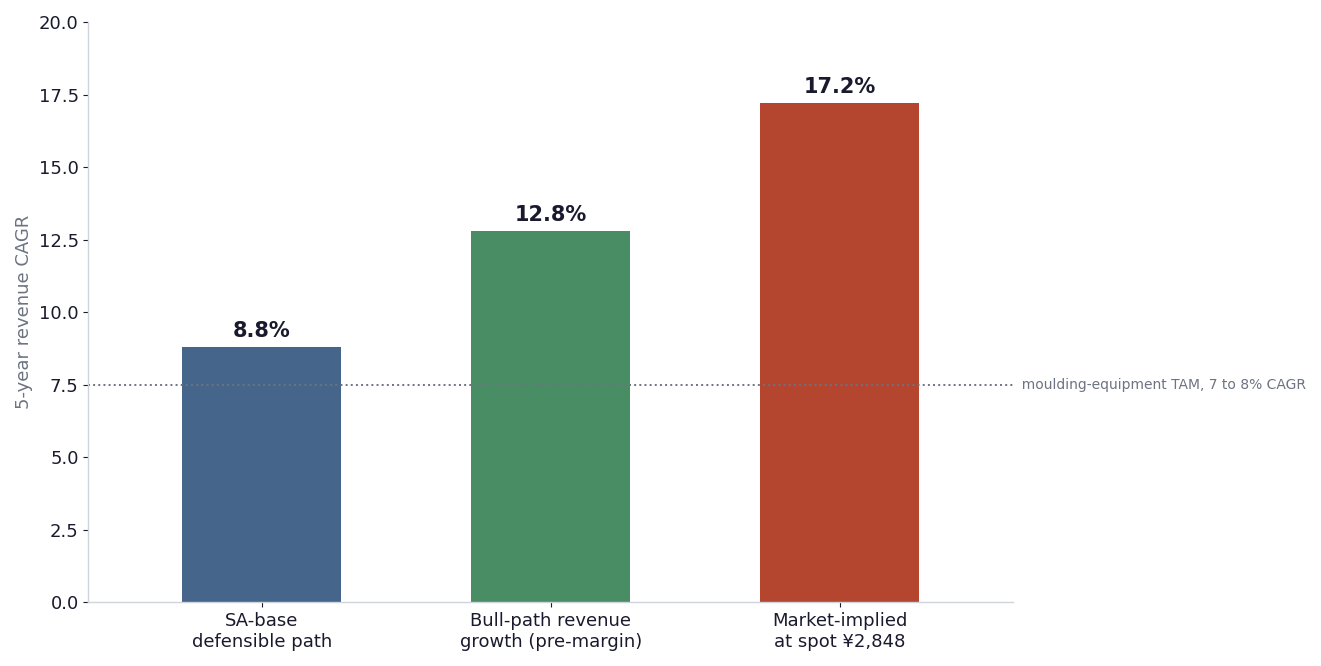
The bull case reaches its ¥3,137 fair value through a 24 percent terminal margin, not through revenue growth above what the market already assumes. Source: dcf_worldview.py public spine, recomputed at spot ¥2,848, 21 Jul 2026.
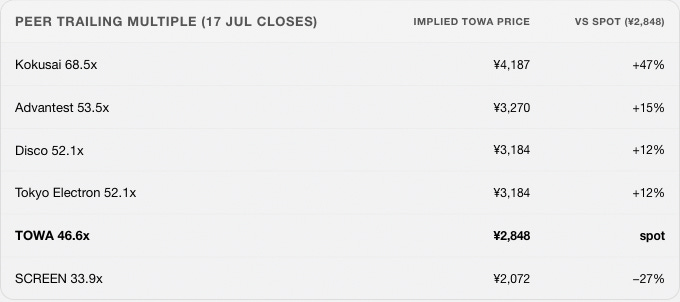
Peer trailing multiples computed close over trailing EPS at the 17 July post-selloff closes (yfinance, pulled 21 Jul 2026), applied to TOWA’s FY3/26 EPS of ¥61.1. One basis across all rows; the prior draft mixed forward and trailing multiples of different vintages.
10 Four scenarios, and for the first time spot clears one of them
The scenarios each flex a different driver instead of the same thesis dialled up and down. The spread is informative rather than a menu for exactly that reason. None of the fair values below has moved since the prior anchor; only the gap to spot has. The Kill weight is the call’s key sensitivity; section 05 carries the evidence for holding it at 22 percent, and a confirmed election at any memory maker moves it, and the verdict, immediately.
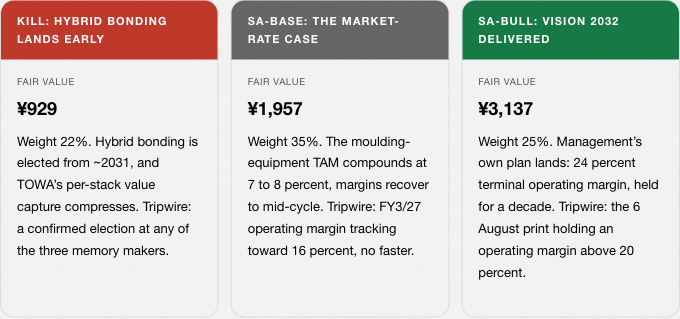
Probability-weight all four (bear Kill at 22 percent, SA-base at 35 percent, SA-bull at 25 percent, and an 18 percent-weighted Cyclical air-pocket case at ¥1,098, not pictured above) and the fair value is ¥1,872, 34 percent below the new spot. A 20,000-draw Monte Carlo over growth, margin, WACC and the yen puts the median at ¥1,689 and the tenth-to-ninetieth band at ¥869 to ¥3,148; at the prior anchor only about 10 percent of draws beat spot, and at the new ¥2,848 close, where spot now sits between the published P75 (¥2,435) and P90 (¥3,148), perhaps 15 to 20 percent of draws clear it, still a minority. A separately built FCFF engine (the Sturzo MIT model, fed our public spine) lands at ¥1,671, a 41 percent discount to the new spot, with its own median at ¥1,776. Two models built differently still agree within about 10 percent of each other.
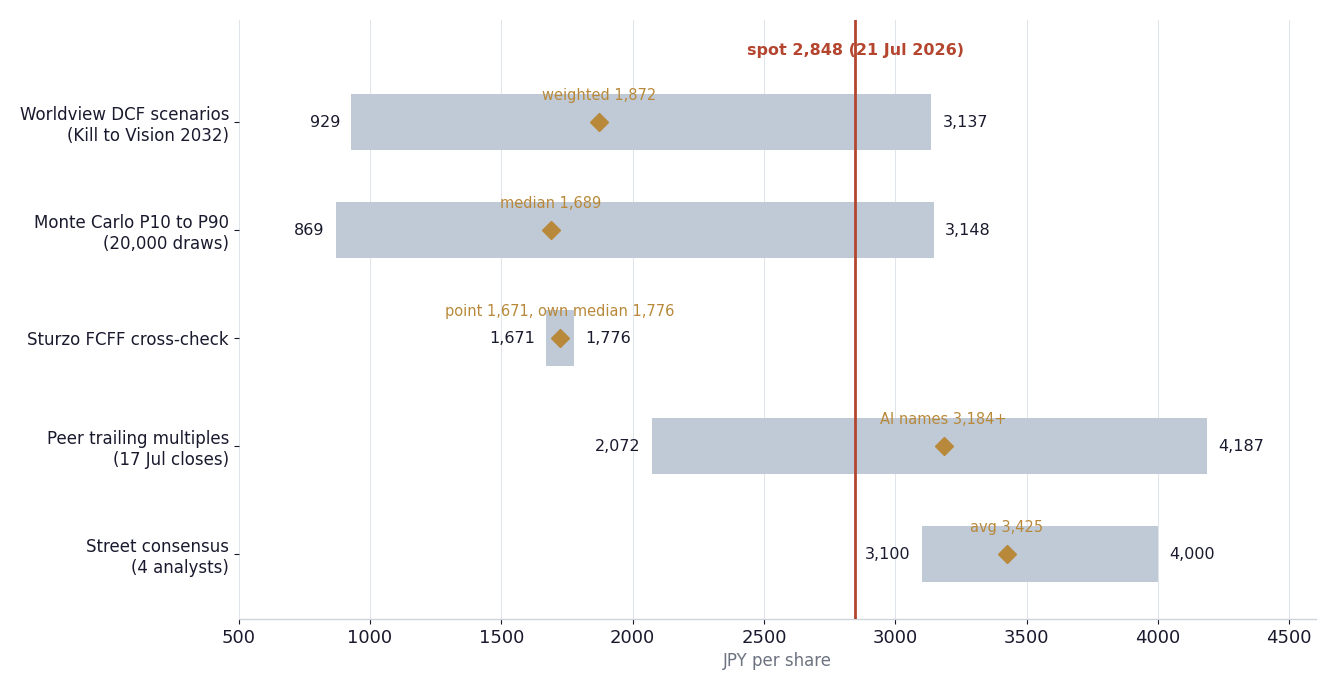
The intrinsic lenses (worldview scenarios, Monte Carlo, Sturzo cross-check) sit below spot; the relative lenses (peer multiples, Street consensus) sit above it. That split is the entire call. Source: dcf_worldview.py, dcf_crosscheck.py and facts-public.json, recomputed at spot ¥2,848, 21 Jul 2026.
Street consensus range of ¥3,100 to ¥4,000 (four-analyst average ¥3,425) per Investing.com, 21 Jul 2026. We could not independently confirm a current ¥4,000 target as Jefferies’ own; Jefferies has repeatedly revised its TOWA target through 2025 and 2026 and we did not treat any single bank’s number as load-bearing. We use the same analyst pool’s forward EPS and reject its average target: the disagreement is the multiple, roughly 45 times forward earnings in the ¥3,425 average against the 25 to 30 times our weighted case implies, and the scenario table prices that disagreement through margins and growth rather than assuming it away. A separate four-analyst average of ¥12,500 to ¥13,800 reported by one data aggregator has the signature of a data error, not a Street view, and we still do not use it.
11 The market has closed part of the gap it never should have priced
Spot fell 21 percent from the 52-week high of ¥3,595 to the new close of ¥2,848, entirely inside a two-session cohort de-rating with no TOWA-specific cause. The effect on the call is arithmetic, not qualitative: every fair value in this note is unchanged, and every gap to spot has shrunk. The weighted fair value moved from 41 percent below the old anchor to 34 percent below the new one; the bull case moved from 1 percent below the old anchor to 10 percent above the new one. A cohort re-rating that leaves the cash flows untouched makes the entry better without making the story better; the entry price is the whole difference between this note and the one it replaces.
12 We hold the chokepoint and wait for a better price
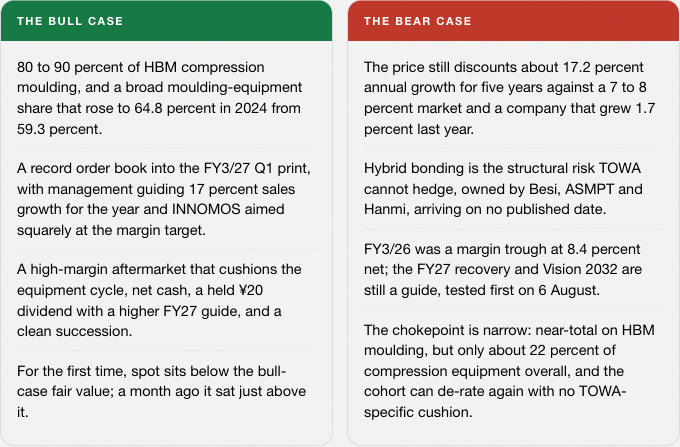
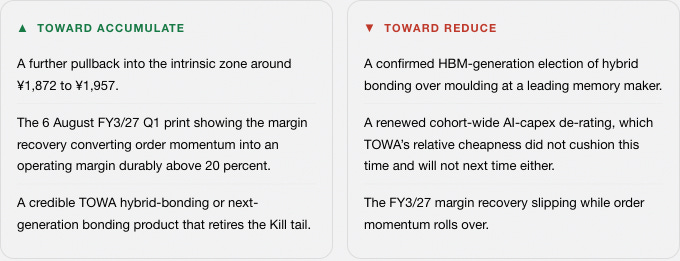
Both halves are real, and the reverse-DCF still answers which one the new price is paying for: mostly the bull, with less spare room reserved for the bear than a month ago. We hold, add only into the ¥1,872 to ¥1,957 intrinsic zone, and trim on either trigger named in section 14: a confirmed hybrid-bonding election, or the 6 August print missing the margin recovery while orders roll over. Between those levels the position waits.
13 The scorecard shows a real chokepoint still priced above its own cash flows
14 What moves the signal from here
15 How we would express it
1\. Hold the position, add only on a further pullback. The bull case now clears spot; the weighted case does not. Size for a further leg down toward the ¥1,957 base case before adding, and treat ¥2,848 as a level to watch, not to buy.
Risk: a confirmed hybrid-bonding election or a second cohort-wide leg down would take the shares through the base case before the entry improves further.
2\. Relative-value pair: long TOWA, short the more expensive cohort names. TOWA’s own multiple (46.6 times trailing) sits below Disco and Tokyo Electron (52.1), Advantest (53.5) and Kokusai (68.5) at matched post-selloff closes; a pair expresses the cohort-discount thesis without taking a view on whether the whole group re-rates further.
Risk: if the cohort recovers together, TOWA’s laggard beta could mean the short leg outperforms the long leg even though the relative call is correct.
16 Dates to watch
The events that resolve the call over the coming months:
6 August 2026: FY3/27 Q1 results. The first hard evidence on whether the margin recovery and the INNOMOS-led plan are converting the record order book into an operating margin above the 8.4 percent trough.
Ongoing: any HBM-generation election of hybrid bonding over compression moulding. Not a roadmap slide, a real order line or a credible channel check. This is the one event that would force a re-underwrite of every fair value in this note.
Ongoing: the cohort. A further AI-capex de-rating across Tokyo Electron, Advantest and Disco would confirm the 15 to 17 July fall as the first leg of a longer repricing, not an air-pocket; a recovery across the cohort would confirm the opposite.
TOWA still owns the step; the market has simply stopped paying for a flawless decade of it in full. Not investment advice. For information and discussion only, and not a personal recommendation, offer or solicitation to buy or sell any security. Capital is at risk, and investments can fall as well as rise; past performance does not indicate future results. The scenario fair values here are the publisher’s own estimates, not a forecast or a guarantee.
All figures are from TOWA’s public disclosures, public market and industry data, and the publisher’s own calculations, current to 21 Jul 2026 unless otherwise dated. No third-party research is quoted or relied upon beyond what is explicitly attributed by name and date above. © 2026 chokepoints.ai, Issue 006, TOWA sits at the moulding sub-step of the AI advanced-packaging stack. The chokepoint is real. The price is closer to fair, not fair yet. All issues
Read the full interactive atlas of the AI compute stack at chokepoints.ai.